

Gradual is the newest platform in this series, and you can feel it. Nearly every other tool I review grew out of a forum. They started as a place to post threads, then added events, content, and everything else over the years, and an old discussion engine still sits at the centre of them. Gradual doesn’t carry that. It was built recently, around events and content first, and the community grew up around those.
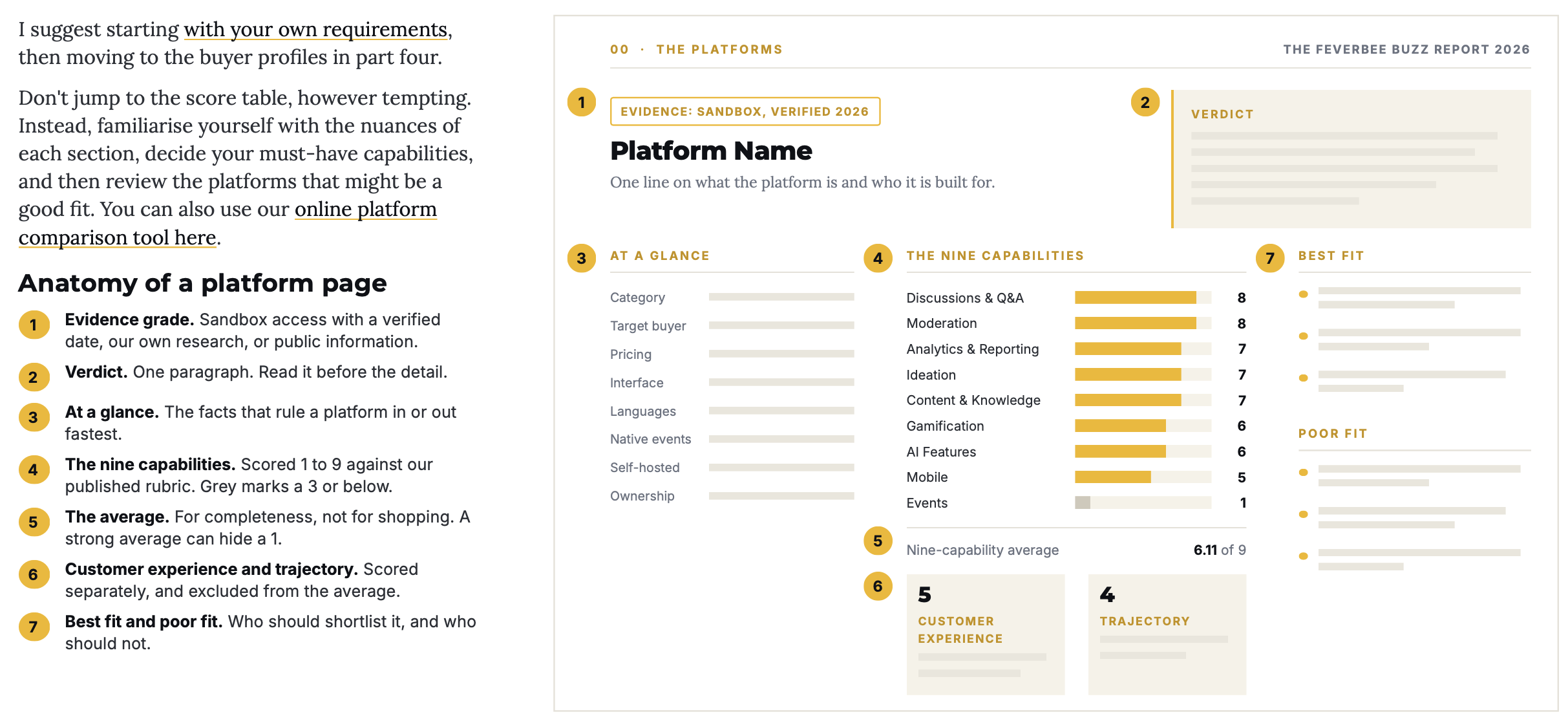
That single fact explains most of the scorecard. I scored it on the same nine capabilities I use for every platform in this series, so you can put it side by side with Higher Logic Thrive, Gainsight CC, and Higher Logic Vanilla. It came out as a specialist. One eight, a band of sevens, two fives, and one real gap at a three. It is ahead of the pack on the things communities have moved towards, and behind on a couple of the fundamentals.
The other thing to get straight early is what Gradual is actually closest to. It isn’t Discourse, and it isn’t Higher Logic Vanilla or Gainsight. It’s Circle.
The Newest Platform In The Series
Gradual is a young company, and for a platform you commit to for years, the vendor matters as much as the features. It started small, powering the occasional event, roughly one a month, for a handful of big early accounts. OpenAI and Perplexity were among the first communities on it, and it has widened out from there to Scale, HeyGen, GE HealthCare, Cognition, and Zwift, among others. A lot of those are the sharp, AI-native, technically demanding companies that tend to be fussy about what they put their name on.
The order is the whole point. Most platforms in the series began as a forum and added events later. Gradual began around the events and the content, and grew the community around that, which is why those parts feel the most finished. It’s a small team with a tight focus, building one well-designed platform rather than a sprawling suite. It’s close to the opposite of Higher Logic Thrive in that regard. It’s also SOC 2 certified, so the enterprise basics are in place.
The downside of being new is that some things aren’t built yet. The analytics are thin, the AI is early, and the ideation barely exists. You get a platform that is ahead on the modern things and behind on a couple of the basics.
The Closest Comparison Is Circle
Think of Gradual as a more customisable, more capable upgrade on Circle. It’s the same all-in-one shape, community and courses and events and content in one good-looking place, but it goes further on most of what I score here and reaches into the enterprise level.
On the nine-capability card, Gradual matches or beats Circle on eight of the nine, and trails it only on mobile by a point. The widest gaps run in Gradual’s favour on events and gamification, and on real questions and answers, where Circle handles RSVPs but not ticketing, has no gamification to speak of, and gives you a feed rather than a proper Q&A. Circle has strengths this card doesn’t score, the paid-membership and creator side especially, and it’s the simpler product. But if you’re weighing Circle, weigh Gradual next to it. Gradual is the more capable tool, and that comes with a higher price tag.
What Gradual Does Well
One capability scores an eight, and three more score a seven: events, content, gamification, and moderation.
- Events. This is the highest score in the whole series. Events in Gradual are the core of the product, not a module bolted onto a forum. When you create one you pick from six native formats, from a meeting or a livestream to a webinar, a hybrid event, an in-person event, or a one-to-one match for mentoring. Open a single event and there’s a full builder underneath: days, tracks, sessions, speakers, sponsors, an attendee manager, and a ticketing setup with ticket types, promo codes, and a separate virtual ticket. It sends the registration and reminder emails, records the sessions and publishes the recordings back into the community’s content, and shows you live attendance while the event runs. The limit is that this is events built for a community, not a standalone events platform at the scale of a dedicated tool like Bevy. For most community teams, that’s the right amount.
- Content and knowledge. This scores a seven, and again it’s native. The content hub covers blogs, videos, podcasts, resources, external content, and collections, and the presentation is good. But the score comes from the courses. Gradual has a real learning platform built inside the community, with video lessons, per-lesson analytics, completion tracking, ratings, an instructor, and a certificate at the end, and you can chain courses, events, and community activity into learning paths that flow through to Credly. Every other platform in this series lost a point on content because none of them did courses natively. Gradual has it built in. What keeps it a seven is that there’s no structured knowledge base in the support sense, so if the job is deflection, it’s the wrong shape.
- Gamification. This scores a seven, which is stronger than I expected. Points, badges, and a leaderboard sit in one place, the badges are designed rather than generic, and there’s room for fifty of them plus your own, each triggered by real activity across events, courses, and the community. The part that stands out is the rewards store. Members can exchange points for physical items, actual products with inventory tracking, a shipping policy, and an order screen to fulfil them, an Influitive-style setup where a hoodie arrives in the post. Where it stops short of the top is the gap Vanilla and Discourse fill: it rewards people, but it doesn’t use that reputation to run the community for you with trust levels that auto-promote reliable members.
- Moderation. This scores a seven, better than you’d expect from a platform this focused on events. You get AI content classifiers for discrimination, sexual content, violence, and personally identifiable information, each with a lenient, standard, or strict setting, plus a profanity filter, a blocked-URL list, and a progressive ban ladder that escalates on its own. There’s a manual review layer behind the automatic one, and event channels get their own moderation. What holds it back is the same trust-level gap as in gamification, and no thread merge or split for tidying messy discussions.
The Best-Looking Platform In The Series
This isn’t one of the nine scores, but it’s a reason people pick Gradual, so it earns its own section. Gradual is the best-looking platform in this series. The graphics, the event pages, the way content is laid out, and the member-facing polish are all a step ahead of the tools that outscore it on raw features. For a brand, or an events and education community, or a marketing-owned one, that isn’t a nice-to-have. It’s part of the job, and it’s something most organisations would happily put their logo on out of the box.
The downside is that the polish comes with limits. When you go into the branding admin you can set logos, favicons, and a single brand colour, and there’s a menu, a footer, and a widgets-and-nudges builder. It stands up fast, but it is not the code-level control of Vanilla’s widget builder or an open Discourse. You’re buying a product that looks great and is limited in how far you can bend it. For most brand communities that trade is fine.
The Middle: Discussions And Mobile
Two capabilities sit in the middle at a six.
- Discussions and Q&A. Gradual’s forum is competent and current. You get up to fifty boards across community, chapter, and topic-level scopes, and six real post types, including answered and unanswered questions tracked separately, so the persistent Q&A is there. Posts carry reactions, views, and a watch count. What it’s missing against Discourse is the modern-forum depth: read-position tracking, real-time presence, wiki mode, and thread merge and split. It’s a very good forum, just not the best one here.
- Mobile. Gradual has native iOS and Android apps, white-labelled to match your community, which puts it ahead of Vanilla and Gainsight, both on a three with no real native app. That’s a quiet advantage worth naming, because almost nobody else in this series has it. Confirm the apps are generally available on your plan when you talk to them, but on the card it’s a real plus.
The Three Gaps
Three capabilities are where being new shows.
- Ideation. This scores a three. Ideas is one of the six forum post types, and members can react and vote, but that’s the extent of it. There’s no dedicated ideation board, no status workflow moving an idea from under review to planned to shipped, and no weighting by account value. If feeding your product roadmap is the main job of your community, Gainsight is miles ahead here at an eight. This is a real gap, not a matter of framing.
- AI. This scores a five, and it’s the thinnest area. The AI you can see today is in moderation, the content classifiers doing a first pass on every post, plus a member-facing system that answers from the community’s own content. It’s early, and it’s a narrower story than Discourse and Gainsight, who are shipping whole suites of AI agents. If AI readiness is the thing driving your decision this year, this isn’t the platform leading on it.
- Analytics. This also scores a five. The overview dashboard is okay, and the per-event and per-course analytics are good. The reporting area gives you a set of ready-made reports you generate and export, covering members, events, content, forum posts, comments, and search history. What it doesn’t give you is the build-your-own dashboard that Vanilla does. If your execs want a board-ready view they can assemble themselves, you’ll feel that gap.
The Verdict: Should You Build On Gradual?
Buy Gradual if your community is built around events and education, if content and design matter to you, and if you’d rather have events, courses, and community in one good-looking product than stitch three separate tools together. It’s a strong fit for a brand or marketing-owned community, and for a customer education motion where the courses and the events are the point.
Look elsewhere if your community is mainly support deflection and product feedback, if mature build-your-own analytics are non-negotiable, or if AI readiness is the one thing you’re deciding on this year. The shape of the scorecard is the whole story. This is a specialist with a clear identity, focused on events and content, with discussions almost secondary to that.
On pricing, Gradual don’t publish numbers, so you’ll be talking to their sales team. As a rough floor, a community of a few thousand members starts around 20,000 dollars a year and scales up from there. The single biggest thing that moves that number is whether you use the platform’s own video calls and webinars, which cost more on Gradual’s side, so leaving those out drops the price a fair bit. Onboarding, training, and support are usually included, and the pitch is that it replaces several point tools at once. As with every platform, get the quote and don’t take a number off a slide, including mine.
Where To Go Instead
If Gradual isn’t the fit, here’s where I’d point you. Pick Higher Logic Vanilla if you want the cleanest question-to-answer-to-knowledge loop for support. Pick Gainsight CC if you’re B2B SaaS and want your roadmap tied to your customer accounts. Pick Discourse if your community is discussion-led and technical. And if you want the simpler, creator and paid-membership version of the same all-in-one shape, look at Circle.
For a brand, events, and education community that wants one good-looking product rather than three stitched together, Gradual is a strong answer. For a lot of teams, it’s the best platform they haven’t heard of.
More In This Series
This is part of my 2026 series reviewing the major enterprise community platforms against the same nine-capability scorecard. If you’re weighing a move, these go together:
- Should You Build Your Community On Higher Logic Thrive?
- Should You Build Your Community On Gainsight CC?
- Higher Logic Vanilla: the full review
- Khoros in 2026, and why I’d leave most teams on it
- Should You Build Your Community On Discourse?
- The scorecard tool for comparing every platform side by side