


While conducting UX research for a client’s community this month, three members said exactly the same thing.
They said they no longer visit the community.
Instead, they use ChatGPT or Claude to ask questions on their behalf, retrieve information, and find out what’s new.
Now, it would be a mistake to over-index on individual anecdotal examples.
But when combined with other signals, it portends a huge change in how people engage with communities. A small, but rapidly growing, percentage of people seem to be engaging with and benefiting from a community without ever visiting it.
It’s Not Just AI Overviews Anymore
We know that engagement in many hosted communities has already fallen between 20% and 40% year on year since Google’s March 2025 core update.
Until recently, this mostly happened because Google’s AI overviews pulled answers from communities into search results, so people got what they needed without clicking through. Now it’s a bigger behavioral change.
And this isn’t just anecdotal.
With the rollout of personal assistants like Instinct, Muse, and Claude Duet, we’re entering an era where more people will engage with a community without visiting it.
Unlike a chatbot, these assistants act on your behalf. They work in the background and message you with what they find, which is exactly what those three members described.
Welcome to the era of headless communities.
What Does A Headless Community Mean?
The idea of a headless community comes from software.
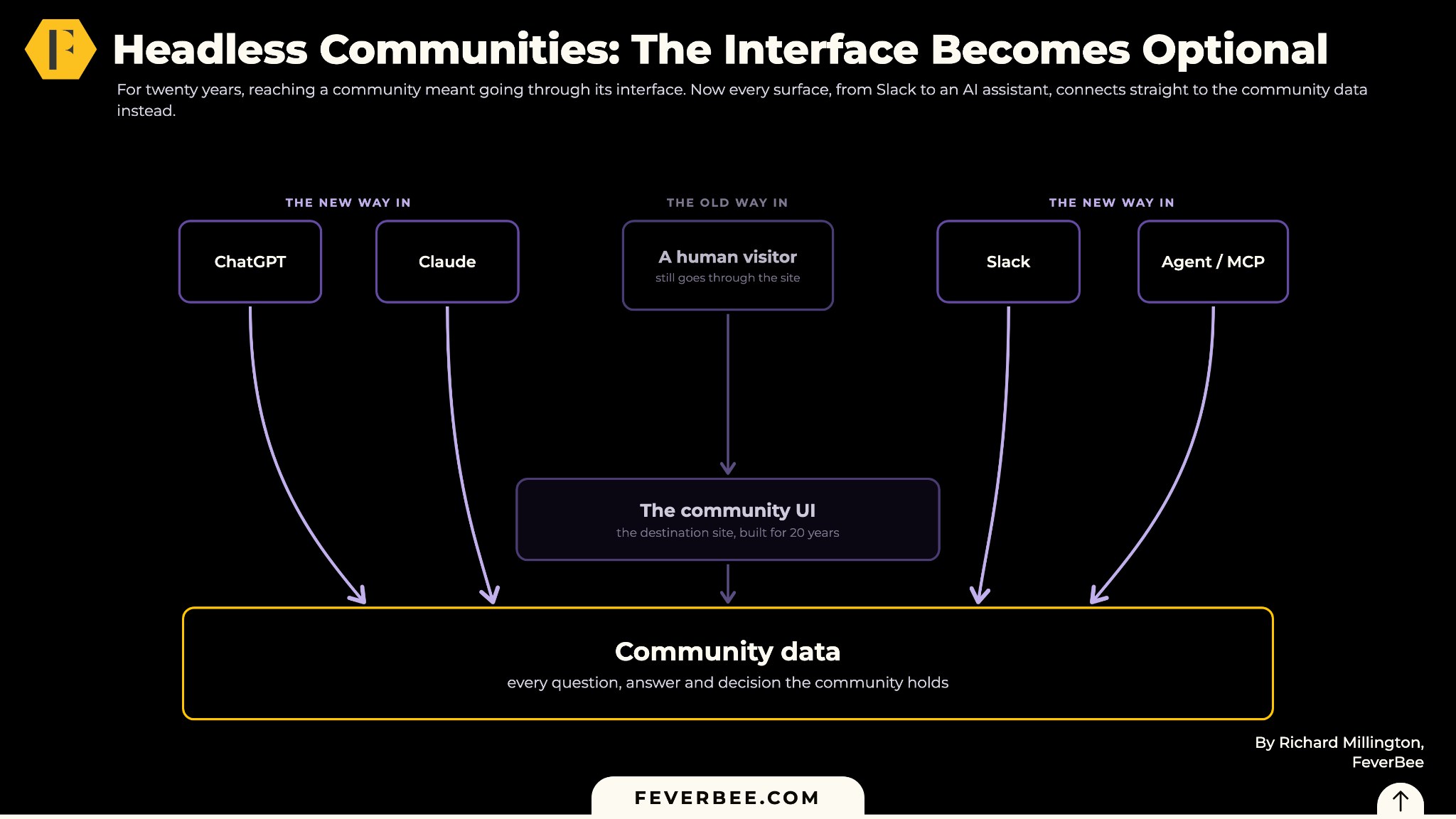
A headless CMS or commerce platform splits the backend, where the content and data live, from the frontend, where people visit, click, and browse.
This means the content and data stay in the same place, but people access them through many channels.
This is far from a new concept.
Many vendors have implemented some form of this already. We’re seeing in-product communities connect to existing enterprise communities, for example.
Some folks have already multiple custom-developed a number of different front doors for a community: perhaps one in-product, perhaps one on the website, perhaps one in an app, and other channels as well.
The difference now is organisations don’t have to jerry-rig a setup to make this work.
Platform vendors are providing it and encouraging organisations to do it. This likely means a proliferation of user interfaces all calling on the same data and content.
MCPs have already made this possible on the back end; now it’s happening on the front end.
Introducing Member-Facing MCPs
And speaking of MCPs, member-facing MCPs are starting to appear.
Mighty Networks already lets members connect their own AI assistant to a network, and more vendors are likely to follow. This essentially encourages members to engage with a community without visiting it.
They can simply submit their request through Claude, ChatGPT, Copilot, or whichever LLM they prefer.
In short, the familiar hosted community experience we’ve relied on for the last 20 years will likely fade into the background.
In its place will rise a wide range of different front-end experiences, and this has huge implications for how we think about designing and measuring a community.
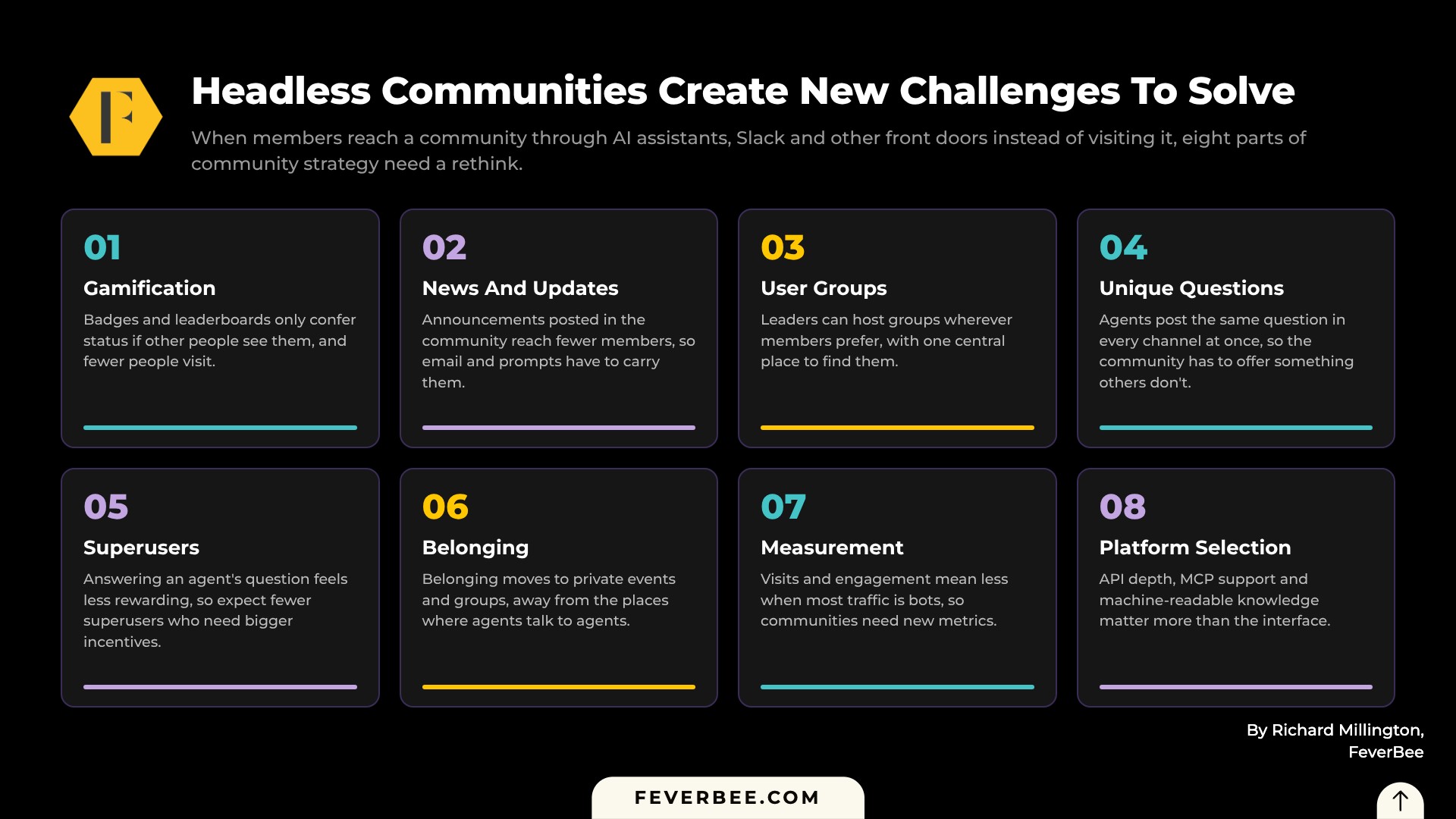
Headless Communities Create New Challenges To Solve
What happens when no two members will experience the community the same way?
Well, this has some obvious implications. Let’s go through a few.
1) Gamification
If fewer people see each other’s gamification badges, points, levels, and leaderboard rankings, gamification probably becomes less valuable to the people who care about it.
While some people undoubtedly like collecting badges and points for their own sake, I suspect many of the highest contributors like the status it affords them within a community. But they will only have that status if other people visit that community.
So we need to find a new way of providing people with that status, and that will probably come from a centralised page that pulls in contributions from both on and off the community. But this will require a completely different point system and approach.
2) News And Updates
Many organisations rely on a community to disseminate news and updates, but if fewer people visit that community, members won’t see them. Instead, you will need to distribute them by email as well, and in some cases, you already do.
Or you have to create prompts that people can use to get the information they need from a community and encourage them to use it. This is the same challenge as persuading people to download and use an app: not impossible, but difficult. Many phones are littered with unused apps where good intentions met the brutal reality of prioritisation.
So it’ll be less effective to post news and announcements on the community in the future.
And this applies to anything related to discovery.
If you’re hoping to post something in a community for people to discover unintentionally while they’re browsing for something else, that’s likely to be less effective in the future than in the past. This might affect things like user groups, upcoming events, and any time-limited or time-sensitive things.
3) User Groups
I’ve long been suspicious of user groups being hosted on a single platform versus a decentralised approach where leaders can host groups on any platform that they like and that they know the audience will prefer.
Too many community platforms already host too many subgroups on life support with limited or no activity.
With fewer people visiting the community, it makes no sense to host most groups there. Instead, leaders should be encouraged to build groups wherever it makes sense. There should be a central place, similar to what Notion does, to share these groups with those interested.
4) Discussions
Two interviewees at the beginning of this article mentioned the same thing.
When they have a problem, they ask their AI tool (Claude/ChatGPT etc…) for an answer.
The agent scans all available sources to find the answer. If it can’t find a satisfactory answer, it asks a question. But it doesn’t just ask in a hosted enterprise community.
It asks a question in every channel available to it.
That might include filing a ticket. That might include the hosted community. That might include other communities on the topic. It might include Reddit, etc.
This means the same question is appearing in multiple places at once. Then it schedules a task to check the responses every hour or so and retrieve an answer.
This behaviour isn’t completely new. We’ve previously found folks tend to publish the question in as many places as possible and see what responses they get.
But now AI tools are going to enable people to automate this. But if the same question is appearing in multiple places, what is the unique value of a community? It might be filled with the same questions and responses as every other channel.
5) Superusers
It’s easy to imagine that, for most support communities, the future will be agents asking questions and other agents answering them.
This will probably start by clarifying what kind of question it is and whether the answer lives in documentation and knowledge. In which case, the organisation-created agent will simply retrieve that information and post it as an answer.
But if not, this would notify or tag the human experts (superusers or internal) to provide the answer. Internal staff would probably wait 24 to 48 hours and then pick up the questions members couldn’t answer.
But this raises an interesting question.
The major benefit of answering the question is knowing you’re helping someone. Do you get that same good feeling if you know an agent posted the question and the person didn’t make the effort to post a question themselves?
The incentives required for superusers will likely have to increase significantly to compensate for the decline in gamification and the reduced sense of helping individuals.
I suspect because of agents, we’ll have fewer superusers, but more incentivised ones.
6) Belonging
Also, what happens to belonging?
Will people still feel a sense of belonging when a growing percentage of activity is driven by bots?
This is dead internet theory playing out inside a community. Agents talking to agents in a community sounds almost Black Mirror-level apocalyptic.
I suspect if we want belonging, it won’t happen in an open, public Q&A experience like it did in the past. Instead, if we want belonging, we’ll have to work much harder to cultivate it by hosting private events and groups, and do much better facilitation of those activities. It will happen, but it probably won’t happen in the same places agents engage.
7) Measurement
One obvious problem with this, one that we’re running into already, is: how would you measure this?
This is the final nail in the coffin for measuring engagement, because there is less and less engagement to measure. Do we measure questions resolved, total answers across any surface, or the extent to which AI support leans on community? Or do we find other metrics of community retention instead?
There’s literally no point in measuring anything related to traffic if most of that traffic is bots.
I’ve written before about measuring ghost deflections and why call deflection has had its day.
Any metric built upon visits is now redundant. We need to find new means of measurement.
8) Platform Selection And Optimisation
This also significantly affects platform selection.
It’s well known that a community homepage is more important internally (showing off the community to other staff) than externally (to members) because the vast majority of people just visit a discussion beyond the homepage, get the answer they want, and leave.
But now the interface features of a community matter even less.
But backend features, like API depth, the data model, MCP support, identity, data portability, analytics, and whether the platform can expose clean, machine-readable knowledge, become far more important. Discourse, for instance, now ships native llms.txt support.
This Is All Guesswork
A lot of this is informed guesswork right now, but I think what’s clear is something big is happening, and it’s going to have a huge impact, especially for everyone that has a hosted community experience.
If we’re designing strategies for the future, we have to think about all of these kinds of questions, especially when we select the kind of platform that we want: the activities we run and what our community is going to be in the future compared to the past, because this will change a lot of things. I don’t think many of us are ready for that yet.
Let’s Set Your Community Up For The Future
I believe most organisations still make decisions based on a community paradigm that no longer exists.
This affects the budget requests they’re making, the platforms that they select, the programmes they’re choosing to run, and where their community team spends most of their time.
And that makes sense because a lot of community teams have had to do more work with less staff over the past few years. This makes it harder to look up from the day-to-day, see where things are heading, and adapt the strategy accordingly.
But the agentic era is coming. Things are changing quickly. Metrics are going haywire. Traffic is going down. Internal priorities are shifting faster than ever before.
If you’re unsure what to do, let FeverBee work through it with you.
We can audit your current community, tell you how prepared you are for current trends, and then work with you to design a strategy and plan that will guide your community into the new era: one where it’s still delivering more value than before, gains more internal support, and becomes an increasingly critical pillar of the customer experience.
If you’re interested, you can click here to contact us.