


The Problem With Community Migrations
We’ve worked on four community migration projects already this year.
In my experience, most organisations have the wrong mindset entirely when it comes to migrations.
Too often, the focus is on replicating what we have on more stable ground vs. building the experience needed for the future.
Or, to be blunt, too often organisations think:
How do we replicate what we have without the baggage of Khoros?
i.e., how do we have a platform that looks and functions exactly the same as what we have today, but without the broken analytics, inconsistent support, and lack of support for our customisations?
Stop doing this.
A Community Migration Is A Rare Trigger Moment
A platform migration (along with renewing your platform) is one of those rare triggers moments that come along every 2 to 3 years to reconsider if your past strategy is fit for the new era.
While organisations shouldn’t make decisions based on sunk costs, they often do.
It’s hard to recommend a drastic change in the community experience one year into a three-year contract – or immediately after a costly migration [with sympathies to the folks who moved from Khoros Classic to Aurora over the past few years].
But the time of renewal (or, better, 18 months before the renewal) is absolutely the time to plan what your strategy should look like for the next few years.
What Is a ‘Strategic Migration’ vs. a Typical Migration?
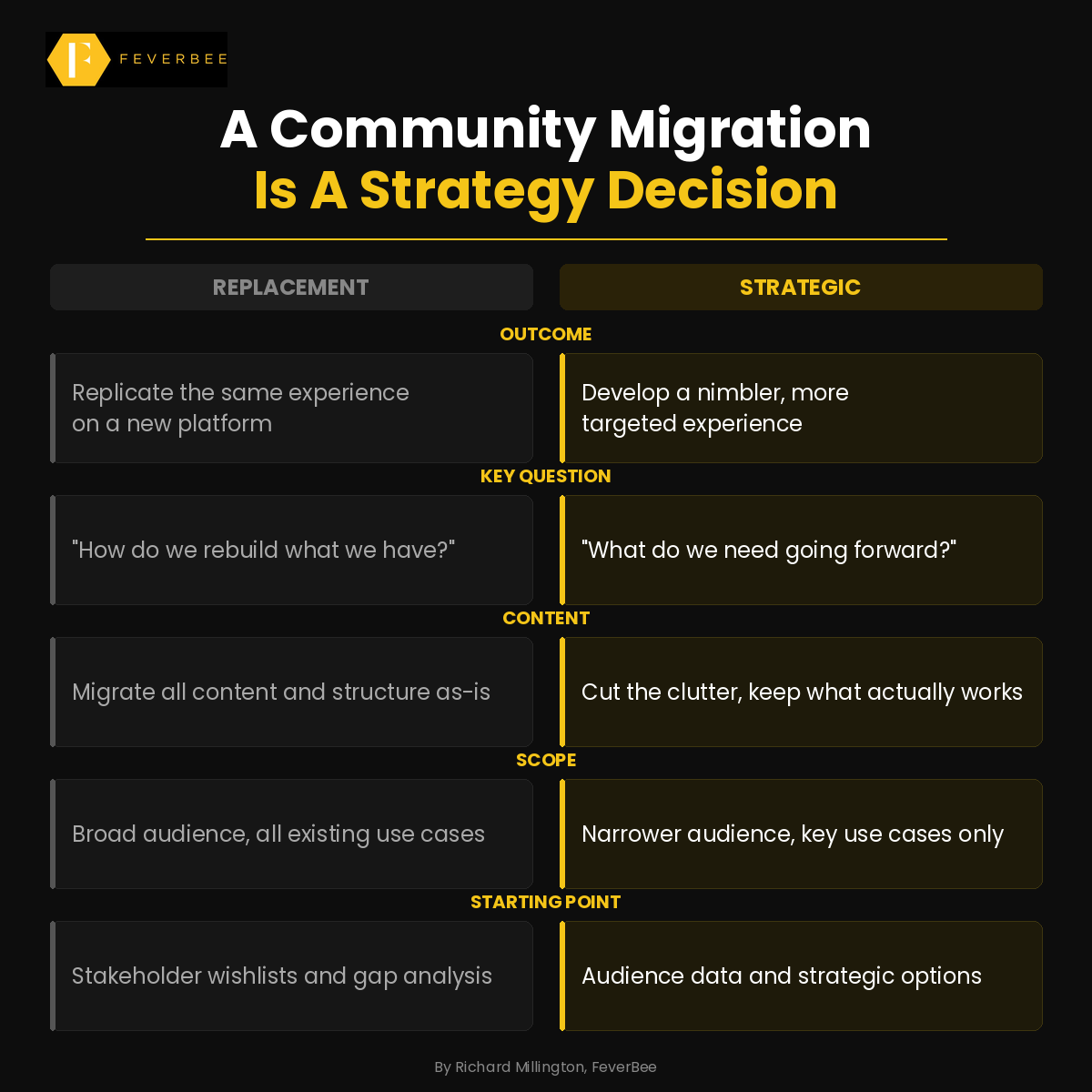
What’s the difference between a strategic migration and a platform swap?
The answer is simple: one focuses on replacing the experience you have today. The other focuses on developing the experience you want/need to offer for the future.
In a typical migration, you would typically do the following:
- Gather the internal stakeholder requirements.
- Undertake UX testing with members to ascertain their requirements.
- Develop the capability gap analysis.
- Put together a requirements specification.
- Create a platform selection criteria and review platforms against the specification.
- Select a platform and begin migrating the content across
But can you guess the biggest problem with all this? It’s designed for the present state, not the future state.
You’re essentially replicating the strategy of the past instead of using the migration as a golden opportunity to consider what kind of community experience you need to offer in the future.
I tackled this in my last post. Many of the assumptions and edifices upon which we built community in the past no longer apply.
Don’t Migrate A Community Without Updating Your Strategy

By strategy, I mean the three big strategic questions.
- What type of strategy do you need?
- What type of community are you developing?
- What kind of community experience do you need to offer?
Each of these is informed by:
- What are the audience needs (and the rate at which they’re evolving).
- What are the organisation’s needs?
- What’s happening in the broader technological landscape?
If you’re not doing this kind of analysis, it’s very unlikely that your platform migration will be as successful as you want it to be.
It might well be the case that nothing has changed, and you need to keep offering exactly the same experience as before.
But the odds are things have evolved, and if you want to take advantage of these changes rather than be buffeted by them, you need to evolve the experience you offer.
Case Study – How To Get The Migration Right
Last year, we worked with a client on their post-Khoros migration.
Instead of beginning with ‘how do we replace’ our current experience, we started with an (online) workshop to define the community’s future needs.
This involved us (FeverBee) gathering extensive data on audience usage patterns, how the audience(s) choose to use each platform, customer surveys, stakeholder needs, the technology landscape, and the long-term viability of each platform.
With that data, we worked up a set of options to collaborate on during the workshop. This included forcing decisions on things like:
- Topic 1: Which audience(s) should we target?
- Topic 2: At which phase of the customer lifecycle does the hosted community deliver irreplaceable value?
- Topic 3: What are the critical use cases for the hosted community going forward?
- Topic 4: What is the role of the hosted community vs. other channels members engaged on (Discord/Reddit/influencer channels).
- Topic 5: What would it take to deliver a 10x better community experience?
Each of these sessions began with clear options to discuss (although there was room to refine/edit them – it just helps to have something to begin with!).
It’s these kinds of questions, backed by data, which will guide you not just to replicate an experience but to design a far better community experience for the future you’re entering.
As a result of these sessions, we were able to undertake a migration which:
- Targeted a more narrowly focused audience than before and satisfied their needs entirely.
- Focused on four specific use cases to solve for the audience.
Based on this alone, we have better copy, cleaner onboarding, and it’s easier to promote the community to the right people at the right time. But this also led to:
- Cutting out almost all customisations. Finally deleting all outdated / non-visited content.
- A much better search experience (faster content, less sludge to search through).
This is what a strategic migration looks like: it goes beyond simply replicating one experience into the next. Instead, it reviews the critical strategic questions against data and then works with a team to evaluate and prioritise the options.
These, in turn, translate directly into the community experience you need to offer.
Sometimes that might be a more expensive experience than before. However, I’m increasingly finding it’s a more targeted, narrower, efficient experience than before.
Aim For A Nimble, Sleeker, Easier To Manage Experience
Too often, migrations go badly because the organisation hoards too much information instead of being strategic and serious about what it will need in the future.
It’s a lot like moving house. You shouldn’t be moving all your possessions from one home to the next. That just stores up problems for later. Instead, think about which possessions you need as you enter each new phase of your life, and adjust accordingly.
The best migrations go far beyond exporting the data, mapping the categories, and trying to replicate the same structure. Instead, they try to cut the bloat, let go of the things holding them back, and design a better future for the path ahead.
Ultimately, don’t treat a migration as a replacement problem. Treat it like the strategy problem it is. And if you need us to guide you through this process, contact us.