


What Is The ‘AI Ready’ Communities Program?
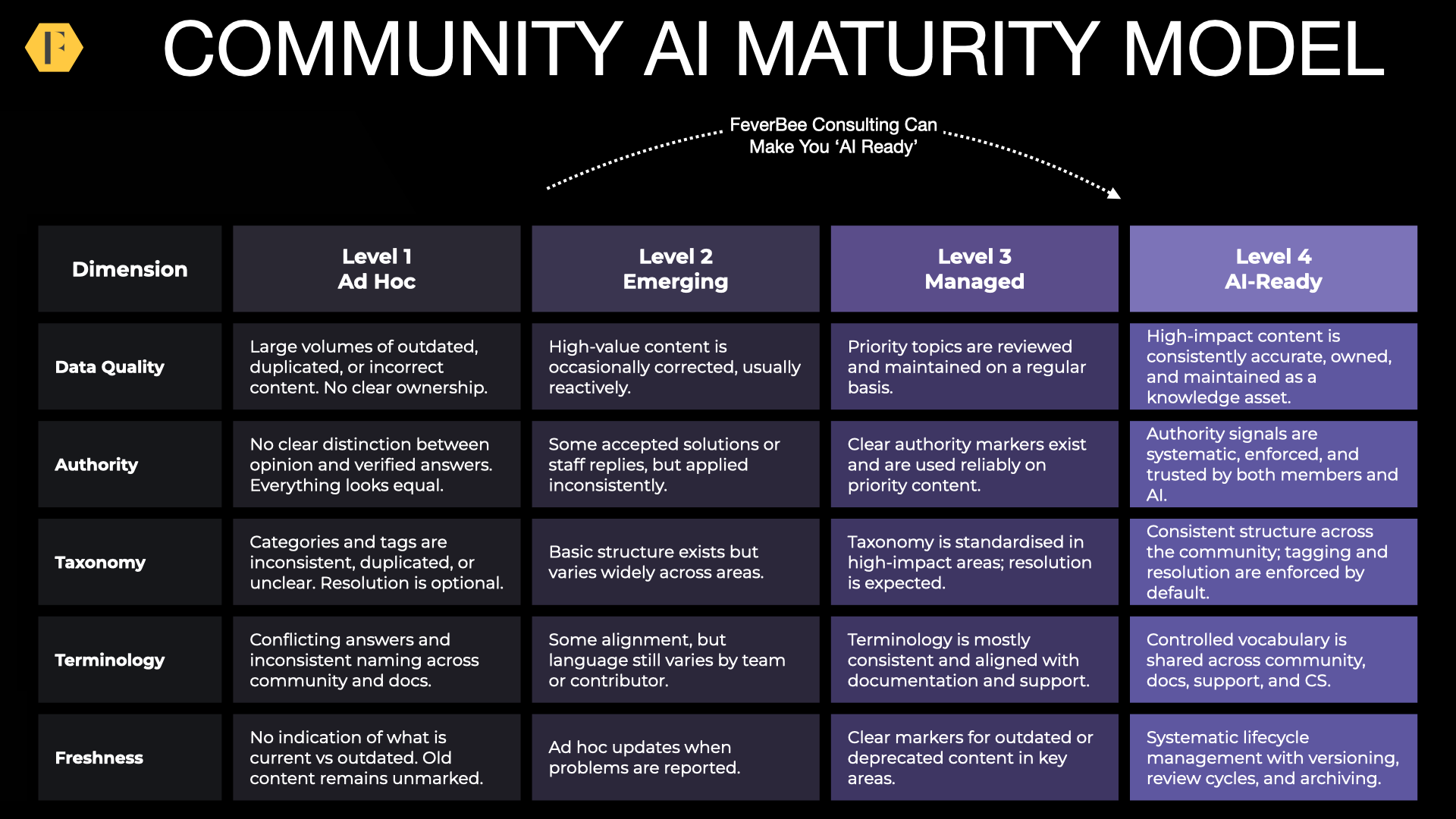
‘AI Ready’ Communities is a three-month, cohort-based working program for community and customer leaders to optimise the incredible collective knowledge in their community for an AI-driven world.
This is not a course, and it’s not a webinar series.
It’s a guided, hands-on programme where a small group of organisations work through the same structural challenges together – supported by FeverBee’s frameworks, facilitation, and direct input.
The focus is not on AI tools or vendor features; it’s on ensuring your community is fit to be trusted, consumed, and amplified by AI.
The program begins at the beginning of November 2026.
How the 3-Month Cohort Works
The programme combines:
Live working sessions (Mon evening)
Structured frameworks and templates
Guided analysis of your own community
Peer discussion and comparison
Direct input from FeverBee
Guest experts
Phase 0 — Evaluation of Community Knowledge
Weeks 1–2
We start by assessing the current status of knowledge within your community.
You will evaluate:
-
The trustworthiness of your content.
-
Where duplication, contradiction, and decay exist.
-
Whether expertise is visible or drowned out by activity.
-
Who owns knowledge, and who doesn’t.
-
Where AI would amplify value vs create risk.
Outputs
By the end of this phase, you will have:
-
A clear enterprise knowledge score
-
A map of high-risk content areas
-
A list of topics that must be fixed before AI touches them
-
Clarity on whether your community is:
-
Unsafe
-
Fragile
-
Conditionally ready
-
Structurally ready
-
Phase 1: Stop the Rot & Fix the Structure
Weeks 3–6
Before redesigning anything, you stop the damage.
1) Stop the Rot
You will define:
What counts as verified or authoritative content
Who is allowed to confirm correctness
How priority questions must be resolved
What content should never be treated as truth
Outputs
Authority and verification model
Resolution rules for high-impact content
AI exclusion boundaries for unsafe content
2) Fix the Structure
The next step is to fix the broader community knowledge structure.
This includes:
Separating conversation from answers from resources
Standardising categories and tags in high-impact areas
Removing vague or misleading structure
Enforcing clean structure on new content
Outputs
Content intent framework (conversation vs Q&A vs canonical)
Standardised taxonomy and tagging for critical areas
“No new mess” content ruleset
Phase 2: Reduce Ambiguity & Improve Community Hygiene
Weeks 7–10
This phase is about signal quality.
1) Reduce Ambiguity
You will:
Define a shared vocabulary for products and features
Consolidate conflicting answers into canonical sources
Clearly mark outdated or deprecated guidance
Align community language with docs, support, and CS
Outputs
Define a shared vocabulary for products and features
Consolidate conflicting answers into canonical sources
Clearly mark outdated or deprecated guidance
Align community language with docs, support, and CS
2) Improve Community Hygiene
You will focus on the content that actually matters.
That means:
Identifying the top 10–20% of threads driving traffic and reuse
Correcting or clearly flagging inaccuracies
Removing misleading content
Assigning clear ownership to critical knowledge areas
Outputs
Top content impact list (highest traffic and reuse)
Verified and corrected high-visibility threads
Archived or removed misleading content
Clear ownership assigned to critical knowledge areas
Phase 3: Freshness Signals & AI Enablement
Weeks 11–12
Only now do we talk about AI.
Introduce Freshness Signals
You will:
Label content as current, outdated, or deprecated
Add versioning and timestamps to authoritative answers
Define review cadences for high-impact topics
Archive content that should no longer surface
Outputs
Content status labels (current, outdated, deprecated)
Versioning applied to authoritative answers
Review cadence defined for high-impact topics
Archive rules for expired or superseded content
Define the AI Operating Model
You will then decide:
Where AI adds real value – and where it should not be used
What guardrails are required for safety and trust
How success is measured in an AI-mediated environment
How governance and escalation actually work
Outputs
Approved AI use cases and exclusions
AI guardrails for safety, trust, and accuracy
AI-ready measurement framework
Community governance and operating rhythms
What’s Included?
3 months of guided cohort sessions
12 personal guidance sessions
Access to FeverBee’s AI readiness frameworks and tools
Peer learning with a small group of comparable organisations
Direct feedback and facilitation from FeverBee
Applied work focused on your community
Investment: $4,000 per organisation (unlimited internal participants)
What Participants Say
“FeverBee’s AI Ready Communities program was instrumental in validating and refining our AI strategy. The guidance on authority and freshness signals, the opportunity to better understand the distinctions between LLM and RAG optimization, and the readiness diagnostics frameworks and tools have provided actionable insights we can immediately apply. Just as valuable has been the opportunity to learn from other organizations in the cohort, helping us benchmark our progress and evolve our Community + AI framework with greater confidence.”
Chris Catania, Head of Community, Esri
“Getting our community ready for AI felt like a huge, vague (perhaps even impossible) project before starting this journey. Richard broke it down into clear dimensions we could actually assess and act on, one week at a time. The sessions were very practical: the most valuable element for me was the several interactive tools he prepared each week. We used them on our own real data, so I was applying what I learned to our actual community in real time, not just in theory. I’d sign up again in a heartbeat.”
Daniele Bozzi, Personio
“This course helped me go from being overwhelmed about how to understand if our community was AI ready, to leading the team on an AI readiness project. Our team now has a firm grip on our AI readiness, and a path to maintain it for the future. The course was really useful in breaking down all of the relevant, related concepts for me to get a clear understanding.”
Joanna Buchmeyer, Senior Community Specialist, User Groups, Jamf
“The course content and the attendees are what made this experience fantastic for me. There was a great framework for success around what we wanted to accomplish, along with incredible people to connect with who were on the same journey. The connections with others in the industry were almost worth the course on their own! Everyone was open and honest about where they are and what struggles they were facing. It was great to learn from those shared experiences and hear about the hiccups others encountered.”
Mitch Gordon, Jamf