


Most Enterprise Communities Suffer From Poor Community Hygiene
It’s becoming increasingly clear that the future value of large, mature enterprise communities will depend on AI surfacing answers to queries across multiple platforms.
For example, I may ask a question in ChatGPT, Google, or a custom tool, and the answer will be sourced from the community.
This means people are less likely to visit the response in its original context; instead, it will be retrieved and integrated with other contextual information.
However, there’s a problem here.
What if the community features dozens of conflicting responses to similar queries? Which would and wouldn’t be used? What if some responses are out of date?
This is a community hygiene problem.
AI Isn’t Magic
Despite what it might seem, AI isn’t a magic box.
It’s a probabilistic tool.
It makes predictions based on past data. If you want good predictions, you need good data. And this is where we run into problems – because many communities have very messy data.
Imagine two questions being asked in your community.
Question A:
“How do I enable SSO for Product X?”
The thread existing in the community contains:
One staff response clearly marked as Verified Answer
An accepted solution
A short, up-to-date summary linking to the official documentation
When AI is asked this question later, it confidently surfaces the verified answer, summarises it, and links to the source.
Everyone wins in this scenario.
Question B:
“How do I enable SSO for Product X?”
The thread contains:
Six conflicting peer replies
Outdated advice from three years ago
No accepted solution
No indication of which response is correct
When AI is asked this question, it still generates an answer – but it’s a probabilistic guess stitched together from noise. The likelihood of it being the correct answer is slim.
Now imagine what happens when you have multiple similar threads with conflicting responses. And imagine what happens when there are hundreds and thousands of differing answers and interpretations of the question and its response.
The likelihood that AI predicts the correct answer decreases quite significantly.
Worse yet, imagine a scenario where AI is trained on data that is significantly out of date. Even new, better, or more accurate answers will carry less weight than a volume of responses that align with a previous answer.
As I wrote a year ago, out-of-date discussions are becoming a big problem. This is even more true today than it was then.
Adding AI to a community with poor data hygiene will do far more harm than good. It will amplify the number of poor responses at the expense of high-quality outputs. This will lead to a worse customer experience and higher dissatisfaction with your products and services.
So, how do we fix this?
What Does AI Need To Be Successful?
To prepare your community for AI, it helps to know what AI needs to work.
There’s plenty of debate here, but we can broadly boil it down into five critical things. These are:
High-Quality Data. Accurate, relevant, and maintained information. AI amplifies errors and decay.
Clear Signals of Truth and Authority. Explicit indicators of what is verified, official, or authoritative versus exploratory or opinion.
Structured Information. Consistent taxonomy, tagging, categorisation, and resolution states that give content meaning and context.
Low ambiguity and consistent terminology. Fewer conflicting answers and stable language for products, features, and workflows. Community categories should align with those in the documentation and elsewhere.
Freshness signals and good lifecycle management. Clear indication of what is current, deprecated, or historical. Recency matters when answers conflict.
When we talk about good community hygiene, this is what we mean.
If you have a large volume of outdated discussions, conflicting responses, and inconsistent tagging and categorisation, you have a community hygiene problem.
The Six Critical Steps to Prepare Your Community for AI
A simple option is to hire us to help you. FeverBee can undertake a readiness audit, clean up your data, and keep it clean in the months and years ahead.
If you want to do it yourself, here’s a sequential roadmap we’ve developed.
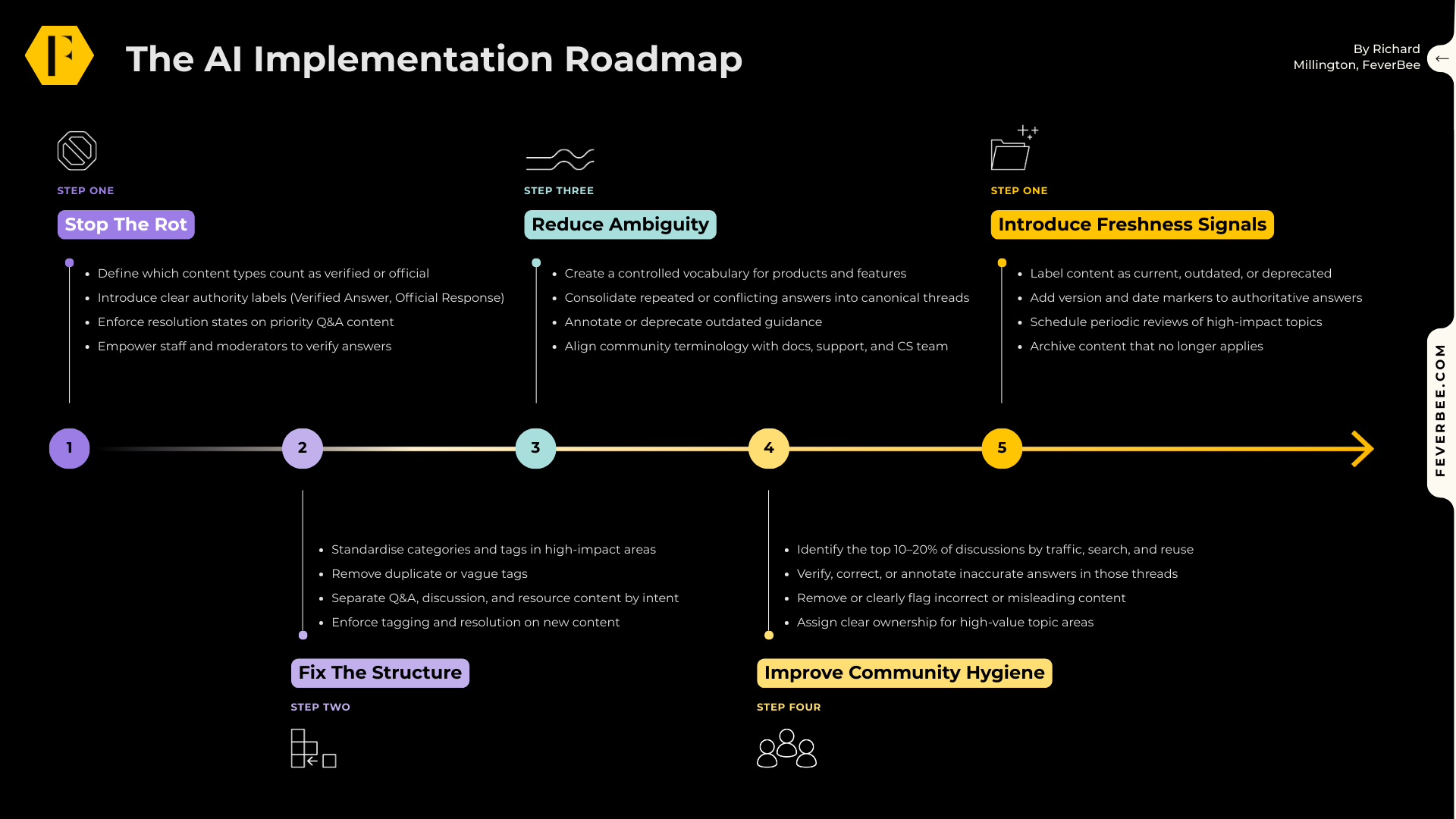
Let’s go through these in more detail:
Step One: Stop the Rot
AI cannot distinguish truth from popularity, so you must prevent it from learning from outdated, incorrect, or ambiguous content.
This step establishes authority and trust signals by clearly defining what content is official, resolved, and verified — and empowering humans to enforce that standard.
- Define which content types count as verified or official
- Introduce clear authority labels (Verified Answer, Official Response)
- Enforce resolution states on priority Q&A content
- Empower staff and moderators to verify answers
Step Two: Fix the Structure
AI performs best when information is predictable and consistently organised.
By standardising categories, separating intent (Q&A vs discussion vs resources), and enforcing tagging and resolution at creation time, you give AI the context it needs before adding intelligence.
- Standardise categories and tags in high-impact areas
- Remove duplicate or vague tags
- Separate Q&A, discussion, and resource content by intent
- Enforce tagging and resolution on new content
Step Three: Reduce Ambiguity
Conflicting answers and inconsistent terminology cause AI to hallucinate or hedge.
This step eliminates confusion by creating a shared language, consolidating canonical answers, and ensuring community knowledge aligns with official documentation and support guidance.
- Create a controlled vocabulary for products and features
- Consolidate repeated or conflicting answers into canonical threads
- Annotate or deprecate outdated guidance
- Align community terminology with docs, support, and CS teams
Step Four: Improve Community Hygiene
You don’t need to clean everything – only what AI and users actually rely on. By focusing on the top 10–20% of high-impact discussions and assigning ownership, you maximise accuracy and value while avoiding unnecessary cleanup work.
- Identify the top 10–20% of discussions by traffic, search, and reuse
- Verify, correct, or annotate inaccurate answers in those threads
- Remove or clearly flag incorrect or misleading content
- Assign clear ownership for high-value topic areas
Step Five: Introduce Freshness Signals
AI needs explicit cues to understand what is current versus historical. Freshness markers, versioning, and scheduled reviews ensure AI prioritises the right answers and avoids confidently resurfacing obsolete guidance.
- Label content as current, outdated, or deprecated
- Add version and date markers to authoritative answers
- Schedule periodic reviews of high-impact topics
- Archive content that no longer applies
If you get these five steps right, you will outperform most organisations.
And if you want help, contact us.