
What Resources Do You Have To Allocate?

The purpose of creating a strategy is to allocate resources to achieve decisive outcomes in favor of your objective.

As you saw previously, there are many exciting optimizations you can make. It is often optimizations that are talked about at conferences, in webinars, and demonstrated in blog posts. These can help, but only to a degree. Ultimately, your performance in any single area is influenced by the amount of resources you have to allocate to that area.

This means we need to know what resources we have to allocate. There are four major resources:

  1. Your time. With very few exceptions, the more time you spend on the task, the better the outcome. Time lets you do more idea generation, more research, build better relationships, go the extra mile in what matters, etc. But time isn’t the only resource you have to allocate here.

    How you allocate your time and the time of your team is entirely within your domain of control. Be aware that some of your time might be taken up by meetings and existing commitments. Estimate perhaps 60% of any individual working full-time on a community could be spent doing community work. Also be sure to include any volunteer time here as well. This might be more flexible, but you can base it on the current amount of time volunteers spend in your community.

  1. Audience attention. You might be able to do a big promotional push to get members to perform a behavior once every few months, but not once a week. There is a law of diminishing returns about audience attention.Tweet This Each message has a lesser effect. This means audience attention is limited and, thus, a valuable resource.

    This is a variable metric, but it is essentially how often you can communicate with your audience before they begin to tune out. You can test the open and unsubscribe rates by email to understand this better. It might also include how many big announcements you can make.
  2. Budget or money. Although different budgets can magically appear and disappear on the whims of stakeholders, let’s assume money is very much fixed. If you have a discretionary budget to spend, you get to choose when and where to spend it. This might be on services that will help you perform your role, on paid support, or other miscellaneous costs (e.g. hosting events). This can often be the difference between publishing a series of blog posts or a professionally designed book. You could just as easily develop a self-published book people can buy if you can afford an editor/designer etc.

    It is not always easy to catalogue a budget. In many situations, your boss will not agree to a budget before she knows where the budget will be spent. Try to understand if there is a broad range of discretionary budget which could be spent on key objectives.
  3. Internal goodwill. This can refer to a number of tangible or intangible assets within the organization. For example, this might include the ability to ask a developer to help you code software you need, or a designer to help you design assets for the community. It might refer to the length of time the organization will give you to demonstrate success. It might be contrary to the organization’s trust to let you do things they perceive as risky.

    It might be hard to catalogue internal resources and your access to them. If you have the broad support of your boss, you might assume you could, if the idea was strong, use in-house resources to achieve your objectives.

Example of Limitation and Allocation

An example of the limitations and allocation questions are shown below.

Finite resources

Limitation

Allocation

Time This is the total amount of time you and your team can spend on any one project. What would you need to stop doing to reallocate your time according to the principles above?
Attention This is the amount of attention your audience will dedicate to the community. What would you need to stop promoting / guiding your members’ attention towards?
Money This is any budget you might have to allocate within the community. What would you need to stop spending on to invest in the above?
Internal goodwill This is how much time and space the organization is willing to give you on risky plans. This includes the permission you have in order to use internal resources to develop your ideas. What are the key risks you need to persuade your organization to take on your behalf?
What will you do with the assets provided by the organization?

This isn’t a comprehensive list of resources and you can probably add your own. These are, however, the most common resources you have autonomy over. You get to decide every day how you’re doing to deploy these resources within your community.

Catalogue Your Resources

The first thing you need to do is to catalogue the resources you have available. This means your budget, your time, the audience’s attention, and internal goodwill (access to in-house assets).

Resource

Limit

Budget $13,000
Time 40 hours per week
Attention 8 emails per month
Goodwill In-house, programmer, designer, boss’ permission, CEO willingness to be involved.

By this point, you should have a clear idea of what resources you have to allocate. Now you just need to know how to allocate them.

Summary

  1. You have four major resources to allocate to achieve your strategy: time, attention, money, and internal goodwill.
  2. Time is the total amount of time you can allocate to community projects.
  3. Attention is the number of messages you can send to your audience before fatigue sets in.
  4. Money is the total budget you can invest in the community (including staff salaries).
  5. Internal goodwill is how much time and space the organization will give you to pursue risky objectives or provide access to key resources (IT, etc.).


Get Approval For Your Strategy

A key feature of a successful strategy is that it is signed off by relevant stakeholders within the organization. This will often just be your boss. Sometimes, it might be a broader group of stakeholders.

The most common mistake here is to present stakeholders with a comprehensive strategic plan to sign off instead of a strategy. There are some clear challenges with this:

  1. The bigger the plan the longer it will take for stakeholders to read. Every additional page reduces the number of people who will read it. Your entire community project might be slowed down not because the strategic plan is good or bad, but simply because it’s long.
  2. If you present an entire strategic plan to stakeholders, stakeholders will often comb through and pick apart every detail. This takes a lot of time and is not likely to lead to the best outcome. This happens partly through an idealized sense of self-importance and partly through the transferral of responsibility. If they approve a strategy and you fail to implement it, it’s your fault. If they approve an entire strategic plan and it doesn’t work out, it’s their fault.

Key Lesson

Solicit Input

One of the best methods to gain approval on any strategy is to solicit input in the strategy. Seeking opinions on the community and engaging people in its creation is far more likely to get your strategy approved.

The key lesson here is you don’t need stakeholders to approve your strategic plan. You need stakeholders to approve your strategy in order to achieve the goals they have set you. This means presenting the objectives and your broad approach to get there. For example, you might explain you plan to increase customer satisfaction by getting members’ questions answered quicker. You will achieve that by making a top group of experts answer more questions. This means making them feel like a unique, superior group of insiders. And this is where you should stop.

If you start talking about the tactics (e.g. meeting with the CEO, showing them a roadmap) they will begin to push back for a variety of reasons. Present the strategy, get agreement on the strategy, and stop for now. This can often work better in some organizations than others which require a comprehensive strategic plan to approve. In this situation solicit as many opinions in developing the plan as you can. If everyone feels like a co-creator, they are less likely to reject it.

At the very least, your boss will need you to approve your strategy. This is because you will frequently need your boss to help you accomplish the key goal of creating your strategy: resource allocation.

Summary

  1. The longer a strategy is, the longer it will take stakeholders to approve it.
  2. If you ask stakeholders to approve an entire strategic plan, expect them to pick apart every detail.
  3. Ask stakeholders to approve a strategy, not a strategic plan.
  4. Explain why this is the strategy and the implications of this strategy.
  5. Solicit engagement in the creation of the strategy to gain buy-in.

Identifying Possible Community Strategies

Don’t develop a strategy without interacting with your audience. You can should go beyond surveys here. Surveys can yield very useful insights about which audience to target or what tactics might work, but it fails to answer a key question.

How do members feel about the behavior you want them to perform?

Speak to your audience and find out how they feel about the behavior today. This stretches beyond asking them what they do and what they think. It means speaking to members who are performing the behavior and understanding how this behavior makes them feel.

We so rarely consider what we want members to feel about the community and their contributions to it. When we do, we default to positive-sounding emotions (e.g. we want members to feel excited and happy). But what do these emotions mean and are they the best emotions to use?

What Does It Mean To Be Happy?

Imagine a member tells you creating great content makes them ‘happy’. You need to probe beyond this. What does happy mean?

Does it mean they feel respected and valued? Does it mean they feel creative and inspired? You need to identify the very specific emotions you want to amplify. This will take work to interview people about their current attitudes towards the behavior.

The first step is to set up as many interviews as you can with people performing this behavior today (aside, simply setting up interviews helps you build useful relationships that will help later on). You need to push very deep at this level to identify the exact emotions they feel. You need to get really specific answers, otherwise your entire strategy might be based upon the wrong emotion.

For example, if you want people to join the community, ask others how it felt to join the community. If you want people to perform a specific behavior, ask those that perform the behavior how it feels. This works better in a direct call/interview setting than it does via surveys.

Data Should Surprise You

The data here should surprise you. We often find the emotion we thought was driving the behavior is not the one most cited. If your data does not surprise you, you might be biasing the data towards what you expected (or hoped) to find.

Don’t confuse justifications with emotions

Be careful not to confuse a justification with an emotion. During an interview, a member might say they share advice because they want to be seen and recognized by others. They might say they want to see how other people react to their posts, or they might say they want to appear as an expert. This is useful information, but it’s a justification for what they do; it’s not the emotion that drives the behavior. You need to push beyond these answers to uncover how they feel when they perform these actions.

They might feel lonely and want to be accepted by their peers when they share advice. They might feel anxious that no-one will respond and excited when they do. They might be jealous of the top experts and want to emulate them.

Identifying The Emotion To Amplify

The answers will always be more nuanced than joy, happiness, and excitement. You need to push hard for people to explain how they feel when they make a contribution. You often need to translate this into an emotion into something deeper. The emotional wheel below will help you push deeper to find the very specific emotion that people feel.

emotionswheel

These emotions will lead into one or more really clear strategies that you can choose between.

Let’s look at three really simple strategies based upon the example above. To illustrate how the strategy changes based upon the emotion, we will keep the goal and objective consistent.

Example 1: Excitement Strategy

Imagine your research revealed that the people who already create quality content feel excited by the response to their contribution. A few might feel anxious by the fact no-one will respond. Others might feel pride in creating something they feel helps a lot of people.

Your strategy would amplify this excitement as we see below:

Goal Generate leads by increasing search traffic.
Objective Increase quality content that ranks highly.
Strategic Objective Get existing content creators to create more content.
Strategy Create a sense of excitement around the response to quality content that has been created. This excitement occurs in seeing how it ranks, how many people mention it, and seeing how much it increases status within the community.

You can see now how this strategy could lead into some obvious tactics around gamification, status-appeals, and notification systems.

Example 2: Respect Strategy

If your research revealed that people who create quality content most desire to feel respected, your strategy should work to amplify this level of respect.

Goal Generate leads by increasing search traffic.
Objective Increase quality content that ranks highly.
Strategic Objective Get existing content creators to create more content.
Strategy Ensure content creators feel respected and valued for their work. This respect must come from people they personally know and respect, not the masses.

You can see here, too, that tactics would not be about gamification or notification systems. Your tactics might focus on levels such as a personal thank you from the CEO, reviews of their contributions by senior staff members, inclusion in staff meetings, etc.

Example 3: Worried Strategy

If people are truly honest in your interviews, you will often uncover darker emotions behind many contributions. One of the most common is fear. People might make contributions because they are worried that something bad might happen if they do not.

Goal Generate leads by increasing search traffic.
Objective Increase quality content that ranks highly.
Strategic Objective Get existing content creators to create more content.
Strategy Build on their worry that they are being left behind, their status is in decline, that others are gaining in popularity.

Again, you can see some clear tactics that might emerge here. You might highlight people who are leading the way in new trends in your field, develop the perception of newcomers on the rise, etc.

Should You Use Negative Emotions?

This is also perhaps the most controversial area of strategic community management. Should we amplify negative emotions to gain behaviors?

You must use your own ethical barometer here. If fear of something bad happening encourages people to create quality content that builds their reputation and improves their condition, that is a mutual win. If it draws people further into despair, that is clearly unethical.

Our advice is to consider whether this behavior would improve your member’s condition. If the answer is yes, then fear and worry can be a powerful motivator to drive positive action. If members are already afraid or worried, it makes no sense to us to ignore this. You can instead signpost your community as a place to resolve and alleviate those worries. If you disagree, you can stick solely to positive emotions.

There are three separate strategies to achieve the same strategic objective. Each of these will lead you down an entirely different set of tactics to achieve your goal. This is why the strategy you decide is so critical. It must be based upon clear research to avoid making a costly mistake in the wrong direction.

You should only have one strategy per strategic objective.

What About The Community Lifecycle?

In our previous work, we have based strategies upon the community lifecycle:

These are the stages communities progress through to maximize the level of activity. For many community professionals, their objective has been to maximize engagement and hope that engagement correlates with additional value.

If increasing activity directly correlates with value, then you should pursue the community lifecycle. This would be the case with advertising-supported communities, communities developed as a hobby, and many others.

The problem is that the correlation between activity and value is often weak or non-existent. In this situation, we wish to pursue a strategy that usually means less engagement overall, but more valuable behaviors. These are the behaviors which drive the best business outcome.

If you are looking to boost activity and maximize engagement, pursue the lifecycle. If you are looking to drive specific member behaviors, pursue a strategic approach to achieve those behaviors.


Summary

  1. Interview people performing the behavior you want to see more of and push deep to uncover how they feel about the behavior. Make this really specific.
  2. Build a strategy around provoking the emotions which appear most often by people who perform the behavior.
  3. Prioritize strategies by those which appear most often, or those which are going to be easiest to execute.
  4. A strategy should not include any mention of tactics or the community lifecycle.

PART TWO – Developing A Community Strategy

The best strategies shut down as many opportunities as possible to focus on a few single, decisive areas. In a community context, you need to find the best way to achieve your objectives above.

A strategy is the emotion that will change the behavior of your target audience. This means that, in order to write a great strategy, you need first to understand what changes behavior. This is where we need to understand a little more about psychology.

What Changes Behaviour?

Facts are far less powerful than emotions when it comes to changing member behavior. Think about climate change. Most people believe that climate change is both man-made and a serious threat to this planet. Yet, few people have changed their ways.

Behavior change is achieved by amplifying specific emotions to evoke a sustained behavior change.

Community strategy is therefore, the science (not art) of amplifying emotions to change the behavior of the specific group of people. A good community strategy identifies the emotion you want to amplify among the group. This is based upon research.

Your strategy is the approach you will take to get members to perform the behavior. As behavior is largely driven by emotions, a good strategy will target a specific emotion and use that emotion to drive the behavior you want members to perform.

Remember, too, that you will need more than one strategy here. You will need at least one strategy for your priority objective(s) and a unique strategy for your failsafe objectives. If you are lucky, the two will closely align. In practice, it is more likely you need to pursue two relatively distinct strategies for different target audiences.

Don’t Worry About Tactics Yet

You don’t want to worry about tactics at this level. Tactics are the specific things (e.g. invite experts to meet the CEO) that provoke the emotion. Tactics are irrelevant at the strategy level. If you get the strategy right, all of your tactics become more effective. Changing the platform, introducing gamification, creating an ambassador scheme, launching a new event… these are all tactics.

Sometimes, they are very effective tactics to achieve a strategy, but they are tactics nonetheless. If they are not strategic, they are taking you in the wrong direction.

A good tactic will significantly amplify an emotion. But a good strategy will amplify the efficacy of all tactics (even the bad ones). For example, a tactic that has a small impact towards amplifying the right emotion is far better than a tactic that has a big impact upon the wrong emotion.

Summary

  1. The purpose of a strategy is to allocate resources to achieve decisive outcomes.
  2. A community strategy makes people feel a specific emotion about the behavior you want them to perform.

Strategic Trade-Offs In Setting Objectives

If you only pursue a single, specific objective mentioned above, will you stop doing the things that keep activity going every day? What about welcoming newcomers? Removing the posts? Maintaining the website, etc? Many of the tasks you perform today, for example, are critical tasks to keep activity ticking over.

Trade-offs to Succeed

This is where you have to understand the trade-off required in strategic community management.

If you want to increase the quantity of valuable behaviors, you have to be comfortable with a decline in some of the metrics you measure today. This is natural. You are shifting resources away from maximizing engagement and towards strategic goals. The challenge is to identify what level of decline is within your comfort zone.

It is important to have clear, strategic, objectives to hit. You should decisively allocate your resources (more on this later) to achieve that objective. However, you should not allocate all of your resources to achieve this (or these) objective(s). You still need to perform many other tasks that keep a high level of growth and activity in the community.

You cannot hope to decisively increase the number of newcomers joining the community if you only allocate another 10% to 15% of our resources to promoting the community. Yet, you would see a huge change if you commit 70% of your resources to achieve this goal.

This leaves 30% to best sustain the level of activity from members we have now. It’s at this point we set a failsafe. What kind of decline are we comfortable with? This should usually between a 5% and 30% drop in growth or engagement, which is acceptable in order to achieve our goal.

The critical thing is to include this failsafe as its own unique objective.


Previous Objective: Increase the quantity of content created by existing, active community content creators to attract high levels of search traffic.
New Strategic Objective 1) Increase the quantity of content created by existing, active community content creators to attract high levels of search traffic.
New Strategic Objective 2) Ensure newcomer rates remain within 12% of the current levels.

This 12% failsafe depends entirely upon the number of resources you allocate. For example, if you allocate 95% of resources, you might expect a 30% drop. If you allocate 50% of resources, you might expect closer to a 5% drop. This gives you some balance to work with. If you’re not keeping within 12% of current levels, you may need to adjust your resources accordingly.

It is also critically important you prepare any internal stakeholders for this drop in engagement metrics. If you do not, you could find yourself facing serious problems later on.

Summary

  1. You need to pursue a clear, strategic objective, but do not ignore sustaining a level of engagement.
  2. Decide what level of engagement drop you are comfortable with and prepare for this drop in advance.
  3. Set a fail-safe metric in your community objectives to ensure that the level of growth or activity still remains relatively high. This is usually set between 5% and 30%.
  4. Write this fail-safe metric into the objectives as a clear percentage. If you fall below this, reallocate more resources to this group.

Who Is Your Target Audience?

You have identified both the goals and the behaviors (objectives) which will likely accomplish these goals. Remember to drop these into your template. Your next challenge is to make these objectives strategic. This means understanding which audience you will target and why.

This level does not concern your stakeholders, but it does determine what you will do and why.  In the previous chapter, you learned the goal of the community is to maximize the quantity of valuable behaviors. However, you face some limitations here.

Keep Members Satisfied

You cannot repeatedly message members to perform the behaviors you want. That will annoy your members and drive them away. You can only maximize the quantity of valuable behaviors by keeping members satisfied and influencing their behavior in ways that add value to them.

Ansoff’s Matrix

Igor Ansoff in 1957 introduced a simple matrix for planning marketing strategies, which continues to be widely used today. We can adopt this to maximize the number of valuable behaviors we highlighted previously.

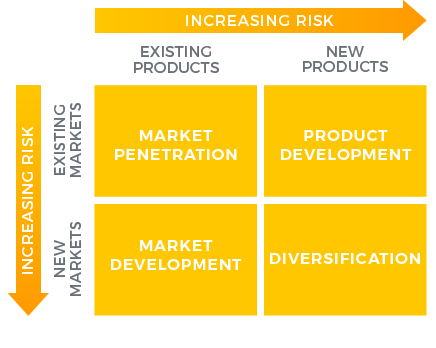
Ansoff’s Matrix identifies four ways to maximize sales. These are to sell more existing products to existing customers,  sell new products to existing customers, sell existing products to new customers, or sell new products to new customers.

These are known as market penetration, market development, product development, and diversification strategies. You can adapt this to your community.


How to Maximise the Behavior You Want

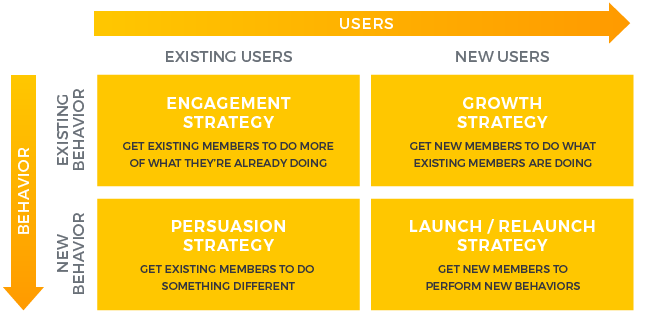
If you want to maximize the number of valuable behaviors, you need to figure out if it’s easier to get existing users to perform more of their existing behaviors, get existing to perform new behaviors, attract new members to perform existing behaviors, or attract new members.

These four quadrants also lend themselves to a selection of strategies we see below.

ansoff-matrix-users-behavior

What audience should you target?

Your primary community objective(s) will target just one of these four audiences (you will have other objectives too, but we will come to those shortly). The quadrants will depend upon whichever approach is most likely to maximize the number of valuable behaviors being undertaken.

This relies upon four key questions:

  1. Is it easier to increase current behavior from existing members?
  2. Is it easier to change the behavior of existing members?
  3. Is it easier to attract more members?
  4. Is it easier to attract more members and change their behavior?

Examples of target audiences

Target Audience

Existing users who already perform the behavior you want. Existing users who don’t perform the behavior you want. New users who perform the desired behavior elsewhere (outside the community) New users who do not already perform the behavior.
Goal Maximize the level of engagement from existing members. Get current members to perform valuable behaviors. Get members most likely to perform the behavior to do so within the community. Get new members to join and perform new behaviors within your community.
Assumption Current members can spend more time performing this behavior It is easier to persuade existing members than attract new ones. It is easy to get new members to join the community and continue their behavior. There are plenty of potential members who will perform and find value in the behavior once they learn about it.
Use When Growth is stagnant (mature) and a large % of existing members are performing the behavior. Growth is stagnant (mature) and a small % of existing members perform the behavior. Growth is increasing and most newcomers perform the behavior you want. Launching a new community from scratch or when nothing else has worked.
Types of Strategy / Tactics Engagement Strategy

Technology (mobile, site improvements, reminders, gamification etc..)

Sense of community

Persuasion Strategy

Content, newsletters, building new social norms with a small group.

Growth Strategy

Direct outreach, conversion, promotion, SEO/content creation, referrals.

Launch/Revamp Strategy

Conceptualize new concept based upon deep research and understanding of the audience.

Knowing the Audience and the Behavior

By now, you should also be able to write very specific objectives. Imagine, for example, your goal is to increase lead generation. The agreed objective might be to get members to create more content which ranks highly in search engines and brings in more traffic (assuming the same percentage of which will convert into customers).

Your primary strategy will depend upon the target audience you choose. You can target four different target audiences to achieve this goal. For example:

  • Objective: Increase the quantity of content which ranks highly in search engines to increase web traffic.
  • Existing users / existing behavior – Strategic Objective: Increase the quantity of content created by existing, active, community content creators to attract high levels of search traffic.
  • Existing users / new behaviors – Strategic Objective: Increase the quality of content produced by existing members to rank highly in search engines and increase search traffic.
  • New users / existing behaviors – Strategic Objective: Attract quality content creators to create quality content within the community to create content in the community.
  • New users / new behaviors – Strategic Objective: Launch a new community to encourage members to create quality content in the topic which ranks highly in the search engines and increase search traffic.

Notice how the strategies for achieving each of these might be very different. Getting existing members to create quality content to generate more search traffic (and thus leads) would be a very different strategy from improving the quality of content from members who are not producing great content today. Likewise, targeting great content creators to join the community is another entirely different approach.

The strategy here might be one of competition between top creators to prove they are the best. This might lead to tactics like incentives, gamifications, etc.

Another might suggest training members to learn what content is great, adding nudges to create content, and gently onboarding members to upgrade their skills. You might need to tackle confidence issues here, too.

The Target Audience Matters

The above highlights just how critical identifying the target audience and the behavior is to developing a coherent community strategy.

This shows you where to spend your time to get the best results. Trying to get people to do more of what they already do, as opposed to trying to get someone to do something for the first time, would lead you down two completely different approaches.

You might have noticed the problem with setting a single objective. What happens if you pursue a strategic objective and the overall level of growth and activity within the community declines? You cannot get more members performing a specific behavior if the number of members plummets.

Summary

  1. Use Ansoff’s Matrix to determine quadrant of people or behaviors you are going to target.
  2. Set strategic objectives which target a specific group of people to perform a very specific behavior (valuable behavior or joining the community).
  3. Slight changes in the quadrant you focus your efforts on lead to radically different approaches in strategy.

Objectives and Stakeholder Relationships

It is important not to keep the community objectives to yourself. Every senior stakeholder might understand what the goal of the community is. However, you also need to take the time to ensure they understand what the objectives of the community are.

This ensures them to make a direct connection between the work you do and the value you create. You’re not just getting people to chat online; you’re getting people to share knowledge that increases customer satisfaction with the product. This supports the goal of the organization.

It is easy simply to agree a goal and work alone going forward. Do not do this. Proactively build positive relationships with your stakeholders. Keep them frequently updated with progress. Do not let them wonder if the community helps their departments, but make sure they know exactly how it helps. Reinforce this view at every opportunity.

Far too many communities are killed by stakeholders who do not understand exactly how the community benefits themTweet This . This is the most critical lesson to learn about community and value. Your work is not to maximize a random proxy metric of engagement (e.g. posts). Your work is to maximize the quantity of valuable behaviors.

This confusion is the reason why so many organizations ask for data on the level of activity or the number of members. Try to avoid providing this data. Instead, report on your member objectives. Are you seeing more valuable member behavior now? Report on whether the community has helped achieve goals. Always try to focus on value, not low-level metrics.

Summary

  1. Establishing objectives is a collaborative, ongoing process with senior stakeholders.
  2. Once you have set objectives, only report on those objectives, not spurious engagement metrics.

Uncover Your Community’s Goals

Your very first step in any community project is to determine the goal of the community as established by leadership.

You should do this in the job interview before you begin working on a community. If it’s too late for that, understand the goals on your first day. If it’s too late for that still, set a meeting with your boss’ boss tomorrow and identify the goals.

Believe us, we know how hard it is if you’re the sole link to the community in an organization that does not appreciate or understand its purpose. However, set a meeting and ask a combination of questions. This might include:

  1. What would you like to see from the community (and why)? Try to link this to a key value metric (see our ROI project) for more information on this.

If this does not yield a useful answer, try something along the lines of:

  1. What are your biggest problems? What opportunities do you see ahead? Look for something that would relate to a clear value metric along the lines of increasing revenue, reducing costs, or social impact (for non-profits).

You need to be really proactive and persistent in understanding the goals for the community here.Tweet This The best approach is to speak to your boss and find out what the goal of the community is. Push repeatedly to understand what behavior the organization is attempting to change and how this fits in with the organization’s broader strategy. Clarify, clarify, clarify…

You might find yourself having to ask several repeat questions to get the real answer. For example, many organizations might set the objective to increase customer loyalty. But does customer loyalty mean people then become advocates? Does it mean they stay as customers for longer? Does it mean they upgrade their products to a premium level, or spend more on related products?

You need to persistently clarify how the community is considered to contribute to the organization’s value.

Setting Your Own Goals Is A Bad Sign

If you find yourself being asked to set your own goals for the community, this is not a good sign. This suggests the organization does not know how the community creates value and is ambivalent about finding out.

You need to work with stakeholders to uncover their biggest problems and see where the community solves those problems. Make sure that your stakeholders accept and agree these goals in order to avoid problems later on.

The Goal Of A Community

A community can have multiple goals; however, one goal should be the priority. The goal should be something that directly achieves value for the organization.

If the goal of the community does not directly achieve value, the community has no value.

For example, “increasing loyalty” or “getting more web traffic” are not directly connected to value. You want to uncover what happens if members are more loyal or you get more web traffic. This might mean better retention rates, more advocacy, or increased sales. These are your goals.

The goal of the community is the outcome of member behavior, it’s not the behavior itself.

Example

A community might be tasked with reducing customer service costs, increasing retention rates, acquiring new customers, increasing employee abilities, or reducing recruitment costs, etc. These are your goals.

These are all clear goals that are easy to understand in terms of value to the organization.

Converting Goals Into Objectives

Once you have the goal (for example, increase customer satisfaction), you can translate this into specific behavior you want members to perform.

This is where you need to carefully consider (or test) what specific actions members need to perform for the community in order to achieve that goal.

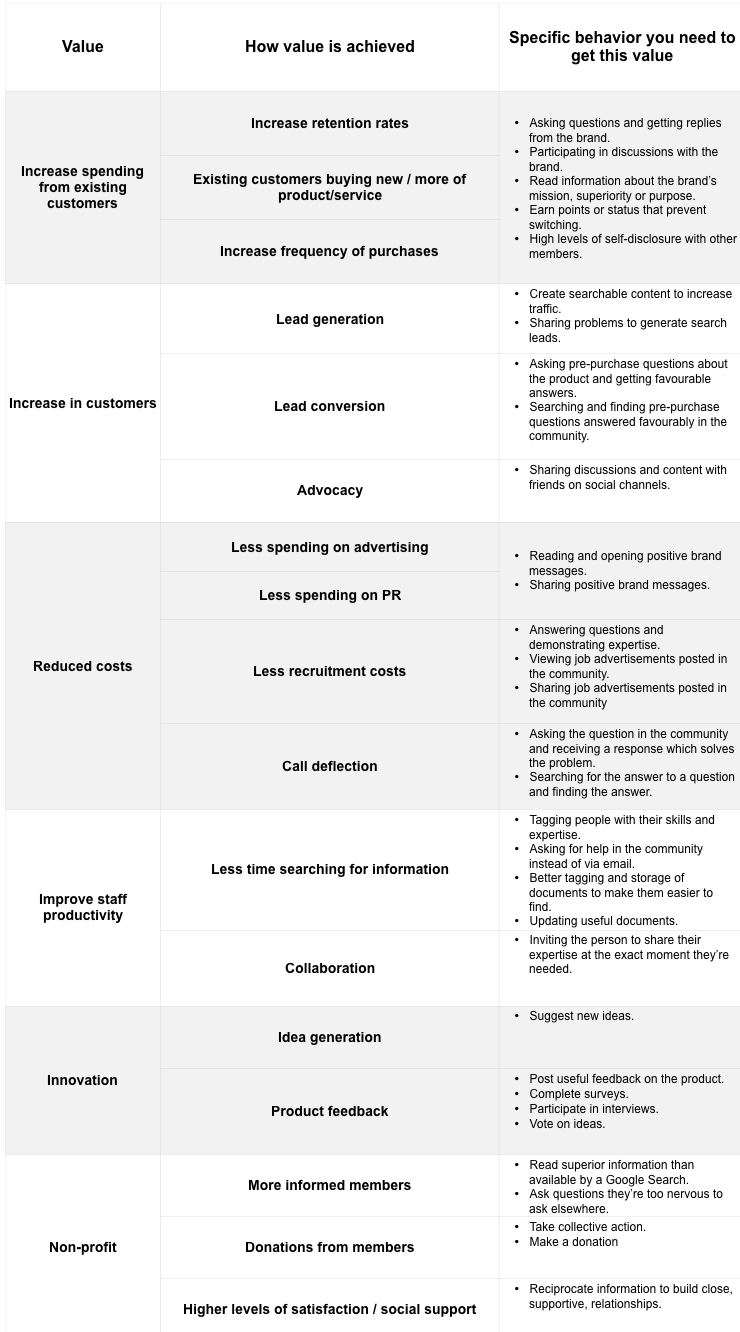
There are two ways of doing this. The first is to use the image below to look at possible behaviors, which might lead to the goal being achieved. You can find some useful examples of converting member behavior here:

MAYBE TURN THIS INTO A TABLE? https://www.feverbee.com/wp-content/uploads/2016/06/onlinecommunityroi1.jpeg.

The Correlation Test

If you think more knowledge shares increases customer satisfaction, you can  run a correlational analysis. See if an increase in knowledge shared (articles, posts, etc.) correlates with an increase in customer satisfaction over the same time period. This is easy to do.

Generating Sales Leads

If the organization’s goal is to generate more sales leads, this might mean increasing traffic to the site, collecting email addresses and information on relevant resources, and members sharing problems in the community, which can be tagged and followed up by the sales team.

This leads to three unique actions that we can track and closely connect to the goal of generating more leads for the business. For example:

Business Goal Community Objectives
Generate leads for the business.
  • Create content/discussions which increases traffic through search.
  • Submit email addresses and information to download resources.
  • Share problems that the brand’s products/services can solve.

Key Performance Indicators

This means we have three specific key performance indicators (KPIs) we can measure to follow success:

  1. Search traffic to content articles created by the community.
  2. Number of email addresses submitted to download relevant resources that suggest buying intent.
  3. Number of problems shared in the community that are tagged as leads.

We could even break this down further. We could identify particular topics that are frequently searched for, identify the kinds of resources that are useful to identify potential buyers, and identify the kinds of problems where the brand can most help. This would be a more precise measurement.

Make sure that the objectives at this stage are converted into specific member behavior which you can measure. Then, make sure that these objectives are also agreed by your stakeholders. If the stakeholders do not agree that these objectives are tied to the goal, you will struggle to prove the value of the community later on. Once we know what these behaviors are, we need to understand how we can maximize them.

Summary

  1. You should not set the goal for your community; instead, you should uncover the goal of your community by proactively understanding the value to leadership.
  2. The goal of a community is to change member behavior. Identify the specific behavior members need to perform in order to achieve the goal.
  3. A community creates value by changing the behavior of its audience.

Community Goals and Objectives

Your very first step in any community project is to determine the goal of the community as established by leadership.

You should do this in the job interview before you begin working on a community. If it’s too late for that, understand the goals on your first day. If it’s too late for that still, set a meeting with your boss’ boss tomorrow and identify the goals.

Believe us, we know how hard it is if you’re the sole link to the community in an organization that does not appreciate or understand its purpose. However, set a meeting and ask a combination of questions. This might include:

  1. What would you like to see from the community (and why)? Try to link this to a key value metric (see our ROI project) for more information on this.

If this does not yield a useful answer, try something along the lines of:

  1. What are your biggest problems? What opportunities do you see ahead? Look for something that would relate to a clear value metric along the lines of increasing revenue, reducing costs, or social impact (for non-profits).

You need to be really proactive and persistent in understanding the goals for the community here.Tweet This The best approach is to speak to your boss and find out what the goal of the community is. Push repeatedly to understand what behavior the organization is attempting to change and how this fits in with the organization’s broader strategy. Clarify, clarify, clarify…

You might find yourself having to ask several repeat questions to get the real answer. For example, many organizations might set the objective to increase customer loyalty. But does customer loyalty mean people then become advocates? Does it mean they stay as customers for longer? Does it mean they upgrade their products to a premium level, or spend more on related products?

You need to persistently clarify how the community is considered to contribute to the organization’s value.

Setting Your Own Goals Is A Bad Sign

If you find yourself being asked to set your own goals for the community, this is not a good sign. This suggests the organization does not know how the community creates value and is ambivalent about finding out.

You need to work with stakeholders to uncover their biggest problems and see where the community solves those problems. Make sure that your stakeholders accept and agree these goals in order to avoid problems later on.

The Goal Of A Community

A community can have multiple goals; however, one goal should be the priority. The goal should be something that directly achieves value for the organization.

If the goal of the community does not directly achieve value, the community has no value.

For example, “increasing loyalty” or “getting more web traffic” are not directly connected to value. You want to uncover what happens if members are more loyal or you get more web traffic. This might mean better retention rates, more advocacy, or increased sales. These are your goals.

The goal of the community is the outcome of member behavior, it’s not the behavior itself.

Example

A community might be tasked with reducing customer service costs, increasing retention rates, acquiring new customers, increasing employee abilities, or reducing recruitment costs, etc. These are your goals.

These are all clear goals that are easy to understand in terms of value to the organization.

Converting Goals Into Objectives

Once you have the goal (for example, increase customer satisfaction), you can translate this into specific behavior you want members to perform.

This is where you need to carefully consider (or test) what specific actions members need to perform for the community in order to achieve that goal.

There are two ways of doing this. The first is to use the image below to look at possible behaviors, which might lead to the goal being achieved. You can find some useful examples of converting member behavior here:

Value

How value is achieved

Specific behavior you need to get this value

Increase spending from existing customers Increase retention rates
  • Asking questions and getting replies from the brand.
  • Participating in discussions with the brand.
  • Read information about the brand’s mission, superiority or purpose.
  • Earn points or status that prevent switching.
  • High levels of self-disclosure with other members.
Existing customers buying new / more of product / service
Increase frequency of purchases
Increase in customers Lead generation
  • Create searchable content to increase traffic.
  • Sharing problems to generate search leads.
Lead conversion
  • Asking pre-purchase questions about the product and getting favourable answers.
  • Searching and finding pre-purchase questions answered favourably in the community.
Advocacy
  • Sharing discussions and content with friends on social channels.
Reduced costs Less spending on advertising
  • Reading and opening positive brand messages.
  • Sharing positive brand messages.
Less spending on PR
Less recruitment costs
  • Answering questions and demonstrating expertise.
  • Viewing job advertisements posted in the community.
  • Sharing job advertisements posted in the community.
Call deflection
  • Asking the question in the community and receiving a response which solves the problem.
  • Searching for the answer to a question and finding the answer.
Improve staff productivity Less time searching for information
  • Tagging people with their skills and expertise.
  • Asking for help in the community instead of email.
  • Better tagging and storage of documents to make them easier to find.
  • Updating useful documents.
Collaboration
  • Inviting the person to share their expertise at the exact moment they’re needed.
Innovation Idea generation
  • Suggest new ideas.
Product feedback
  • Post useful feedback on the product.
  • Complete surveys.
  • Participate in interviews.
  • Vote on ideas.
Non-profit More informed members
  • Read superior information than available by a Google Search.
  • Ask questions they’re too nervous to ask elsewhere.
Donations from members
  • Take collective action.
  • Make a donation.
Higher levels of satisfaction / social support
  • Reciprocate information to build close, supportive relationships.

The Correlation Test

If you think more knowledge shares increases customer satisfaction, you can  run a correlational analysis. See if an increase in knowledge shared (articles, posts, etc.) correlates with an increase in customer satisfaction over the same time period. This is easy to do.

Generating Sales Leads

If the organization’s goal is to generate more sales leads, this might mean increasing traffic to the site, collecting email addresses and information on relevant resources, and members sharing problems in the community, which can be tagged and followed up by the sales team.

This leads to three unique actions that we can track and closely connect to the goal of generating more leads for the business. For example:

Business Goal Community Objectives
Generate leads for the business.
  • Create content/discussions which increases traffic through search.
  • Submit email addresses and information to download resources.
  • Share problems that the brand’s products/services can solve.

Key Performance Indicators

This means we have three specific key performance indicators (KPIs) we can measure to follow success:

  1. Search traffic to content articles created by the community.
  2. Number of email addresses submitted to download relevant resources that suggest buying intent.
  3. Number of problems shared in the community that are tagged as leads.

We could even break this down further. We could identify particular topics that are frequently searched for, identify the kinds of resources that are useful to identify potential buyers, and identify the kinds of problems where the brand can most help. This would be a more precise measurement.

Make sure that the objectives at this stage are converted into specific member behavior which you can measure. Then, make sure that these objectives are also agreed by your stakeholders. If the stakeholders do not agree that these objectives are tied to the goal, you will struggle to prove the value of the community later on. Once we know what these behaviors are, we need to understand how we can maximize them.

Summary

  1. You should not set the goal for your community; instead, you should uncover the goal of your community by proactively understanding the value to leadership.
  2. The goal of a community is to change member behavior. Identify the specific behavior members need to perform in order to achieve the goal.
  3. A community creates value by changing the behavior of its audience.

Elements Of A Community’s Strategic Plan

When we talk about community strategy, we are usually talking about the strategic plan.

A community strategy forms one part of the community’s strategic plan. It’s neither the first nor the last part.

Strategic planning is a process of identifying the broad goal, of translating that goal into member behaviors (objectives) you need to achieve. You then create a strategy (or strategies) to achieve those objectives.

Once you have created the strategy, you identify the best way to fulfil that strategy (tactics). Next, you decide who, what, and when those tactics will be executed (action plan). Finally, you measure and improve.

Key Elements

The key elements of a community strategic plan are below.

  • Goals. This is what the organization wishes to achieve from the community
  • Objectives. Objectives are what behavior you need members to perform in order to achieve this goal
  • Strategy. The strategy includes the emotions you will amplify in order to influence people to perform this behavior
  • Tactics. Tactics are the specific action steps you will execute to amplify these emotions
  • Plan. A plan (or action plan) identifies who is going to execute those tactics, what is required to execute those tactics, and when those tactics will be executed
  • Improve. This is the process of measuring what happened, analyzing why it happened, and making continuous improvements

Strategic Plan Example

You can take many approaches to achieve your goal, multiple strategies to fulfil your objectives and many tactics to implement your strategy. Let’s connect these together into a similar example. The broader business goal might be to increase retention rates of a software platform. The customer success department might do that by building a community that shares useful tips on using that platform better and increasing the perceived value of the product.

  • The community goal is to increase customer retention rates.
  • The objective is to get members to share their best tips on using the product.
  • The strategy might, in turn, be to turn those that share the best tips into stars that others feel jealous of and want to emulate.
  • The tactics can include regular interviews with the top members, webinars featuring stars, inviting these stars to speak at events, or flying them to the headquarters for specific access and previews.
  • Then, our action plan will identify the costs involved in doing these interviews and activities. It might identify who is best suited to do them, when they can be undertaken, and steps required to execute them extremely well.

Notice above how everything fits together. Also, notice how the strategy works. By devoting the majority of our resources to create stars and amplify the sense of jealousy (or admiration), we are taking resources away from other areas and other members. This means you face the risk that this will fail and other areas might be a better use for those resources.

In the next few chapters, you’re going to learn more about the community goals, objectives and types of strategy you might choose.

Summary

  1. A community strategy gets the most attention but forms just one part of the strategic plan.
  2. A strategic plan consists of objectives, a strategy, tactics, an action plan and improvement (measure, analyze, improve).