

Why Create a Strategy?
Strategic Community Management
Not many community professionals writing a strategy have seen one, written one or studied one in depth. This leads to some persistent misconceptions about what a strategy is and what a strategy is designed to do.
In this chapter, you will learn how a strategy works at the organizational-wide level first. Later, you will learn how a strategy is applied to online communities.
What Is A Strategy?
A strategy is the broad approach you will take to achieve goals set by the organization. You don’t set the goals, but you do define the approach that will take you from where you are now to where you want to be.

Do not confuse a strategy with a strategic plan. A strategy is what you will do, while a plan is how you intend to do it. A strategy deals in resources, uncertainty, and understanding risk. A plan deals in execution, tactics, and timing.

What Is A Strategy Supposed To Do?
To understand strategy, you have to understand three principles.
- You have limited resources. Your time, money, and effort are limited. Resources spent on one activity are resources you cannot spend on another. Most strategies we reviewed suggested doing more or doing things better. This is the antithesis of a good strategy.
- More resources lead to improvement. Yes, you can optimize your time, do things faster, and spend more wisely. Ultimately, however, success is driven by resources. To use a military analogy (where the word strategy originates), whichever army brings more soldiers to the battle wins. Strategy is not what you do once the battle begins. Strategy is about winning the battle before it is fought. Strategy is about deciding which battles are worth fighting and then allocating resources to ensure decisive victories.
- A strategy comes before you think about strategy. This is critical to understanding strategy. You must set the strategy before you consider what tactics to use. It is really easy to find tactics you like and then create a reason (or a strategy) to execute that tactic. This leads you down the wrong path. You should not even consider your tactics until you have set a clear strategy.
This second point is crucial. There are many ways you can optimize what you do. But, ultimately, it is the resources you devote to a task that will drive improvement.

For example, imagine you want to create better content. You could read up on how to write good headlines, optimize the material for SEO, and learn the best time to post a new article. These are all small optimizations that might have a <10% impact on readership.
Now imagine what happens if you had $5k, 20 hours, and unlimited organizational resources to create your next article? You could undertake thorough research, hire a top author to create the article, record video, create images, and publish something fantastic. This is likely to give you a double digit increase in readership.
Almost all discussions about improving a task focus on optimizing what you do already. There are plenty of tiny tweaks you can make to do things better. Yet, the secret to getting better is figuring out how to devote more time, money, and resources to the task. This is what leads to a decisive improvement.
Fundamentally, a good strategy should force you to allocate your limited resources to best achieve your goals. This means some areas will get significantly more time, money, and effort. Other areas will get significantly less.

Understanding Risk
A good strategy also means you need to understand the risks involved. When you allocate your resources to achieve a decisive outcome, you are accepting a risk that this might not work.

At the 1996 Atlanta Olympics, Great Britain finished in 36th place in the Olympic Medal table (just behind North Korea, Algeria, and Ethiopia) with 1 gold medal, 8 silver, and 6 bronze. Since then, performance has improved at every subsequent Olympic games. At the 2016 Olympics, Great Britain ranked second with 27 gold medal, 23 silver, and 17 bronze.
The UK Sport strategy to achieve this feat was crude and effective. Instead of spreading resources equally among various sports, Great Britain selected sports with multiple medal opportunities (cycling, gymnastics, rowing) and allocated more resources among the winners. Sports that didn’t achieve success lost their funding (wrestling, table tennis and football). Sports that produced winners received more funding.
Money that might have been spent on better wrestling gear or table tennis equipment was instead spent hiring the best nutritionists and state of the art training facilities for cyclists.
Notice the inherent risk here. If a handful of top stars do not perform, get injured, or fall sick on the wrong day, millions of dollars in funding are wasted. Worse still, those who lose their funding protest loudly and it robs many athletes of an opportunity of competing at the Olympics.
You cannot have a good strategy without risk. Do not try to alleviate risk; instead, try to understand it.
But how does this apply within most organizations?
The purpose of creating a strategy is essentially to force through the difficult decisions about where to spend your limited resources. This will make you feel uncomfortable.
An organization might pursue a focus strategy designed to maximize the share of wallet from a specific (segmented) group of customers.
This will mean the organization will allocate its resources and efforts to focus upon a select group of customers. The organization will hope to gain a dedicated and loyal group of customers as a result. However, to do this, it needs to ignore every other segment in order to achieve its goal. This will mean closing the door to countless opportunities.
This is going to feel risky. It will feel far less risky to spread resources evenly among all potential customers and see what works. However, this ignores a simple reality. You are far less likely to succeed by spreading resources evenly. Imagine you spread your resources evenly among three similar segment groups, yet each competitor concentrates their resources on single segments. You’re almost certainly going to lose.
Apple has consistently pursued a differentiation strategy based around great design. This great design lets Apple charge a 40% gross profit margin compared with 16.2% for Samsung. Yet, this strategy involved trade-offs. Apple loses out on huge markets who cannot afford Apple products. The closed, integrated, system has allowed Google Android to gain a 70% market share in a market Apple invented. Yet, those risks were considered acceptable and have been proven to be correct.
If a strategy doesn’t force through difficult decisions like these, if it doesn’t make you feel uncomfortable, if it doesn’t understand the risks involved and make choices with this understanding, it’s probably not a strategy but wishful thinking. The secret to a successful strategy is focusing your efforts to achieve decisive outcomes.

From Business Strategy To Community Strategy
Almost every large business will (hopefully) have an established long-term strategy set by the CEO and agreed by shareholders. Objectives from this strategy will trickle down through the organizational hierarchy to different departments (finance, sales, marketing, HR, etc.). Each of these will then develop their own strategy to achieve these objectives.
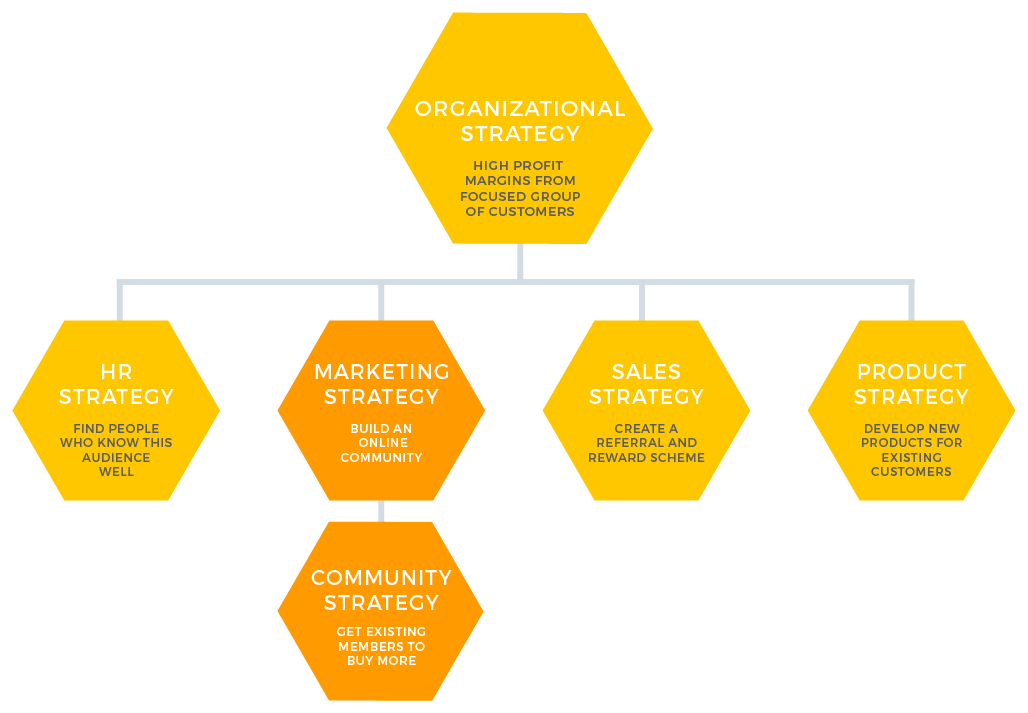
Your marketing department, for example, might create a strategy to increase the share of wallet from existing customers through a combination of product development (developing new products for your existing customers) and promotion (establishing a unique value in the mind of your audience). This promotional strategy, for example, might aim to align the brand with your customer’s own sense of identity (e.g. ‘I am a creative person and this is a creative brand’).
Community strategy vs. Community as a strategy
An online community might have a strategy to achieve goals set by the marketing department. However, the community might also be part of the strategy to achieve the goals of the marketing department.
In most cases (although not all), your community strategy will sit under an existing department and feed into a broader roleTweet This (e.g. within marketing, HR, or communications role. Your community itself might be a strategy created by the marketing department to increase customer retention rates or cultivate advocates. It might be created by customer service to reduce costs, etc.
This is a really important thing to understand. While you create a community strategy to achieve an objective, your community is also part of another department’s strategy to achieve their goals. We often get confused talking about a community strategy and community as a strategy.
For example, the marketing department might decide the best way to align the group identity is to build a community of creative customers. The community is thus a strategy. However, you need to create your own community strategy in order to increase the sense of group identity felt by members.
Rejected Objectives
Sometimes, objectives are rejected by departments due to internal politics. Sometimes, there isn’t a clear objective at all, but a vague idea of improvement. This is especially true in smaller organizations.
The MBA Version Of Community Strategy
Above is the MBA version (or idealized version) of community strategy. It assumes the organization has a clear mission, all departments are in alignment of that mission, and everyone is pulling in the same direction to achieve a single goal.
The reality is often far more complex. Sometimes, objectives don’t trickle down well. Sometimes, they are rejected by departments due to internal politics. Sometimes, there isn’t a clear objective at all, but a vague idea of improvement. This is especially true in smaller organizations.
This means you need to work extra hard to identify specifically how the community fits in with the organization’s broader goals. Are you a part of someone else’s strategy, or a vague concept that you need to turn into clear objectives?
Summary
- A strategy is not the same as a strategic plan. A strategy is what you will do to achieve the goals. A plan is how you will do it.
- Real improvement comes from allocating your resources effectively. A strategy decides what is worth doing and then allocates resources decisively towards those battles. You develop a strategy to force through difficult decisions on where to spend your limited resources.
- You are far less likely to succeed if you spread resources evenly. You need to accept that this feels risky (but it is less risky than spreading resources thinly across many objectives).
- Your community strategy sits within the broader ecosystem of the organization. You have (an) objective(s) you are expected to achieve.
- In many organizations, internal politics means the connections between each department and the organization’s strategy are unclear.

Share
Facebook Facebook
Twitter Twitter
LinkedIn LinkedIn
Google Plus Google+