


Why Is There So Much Conflicting Advice?
You might have read through a myriad of conflicting opinions to overcome these challenges.
Should you:
- Double down on AI and focus on the community being part of the AI tools your organisation is developing?
- Focus on building a sense of belonging that AI can’t compete with?
- Optimise what you’re already doing and ignore the noise?
- Embrace ‘Community Everywhere’ and engage across multiple platforms?
You can see the intuitive logic in each of them – but these lead you down very contrary paths.
The problem is that everyone is extrapolating conclusions from the narrow lens of their own personal experience.
It’s a little like the parable of the blind men and the elephant; it can seem like a tree, a wall, or a snake depending on the feature you touch.
Whether the future of the enterprise community rests in AI, belonging, third-party platforms, or something else entirely depends entirely on how the three major trends impact you today.
The Three Major Trends (and how they impact you)
Over the past few years, three major trends have emerged.
- Changing preferences away from forum-centric experiences and towards a plethora of other platforms to satisfy our needs.
- The sudden explosion of AI and internal pressure to utilise it.
- The sharp decline in search traffic (as Google showcases AI-generated answers/snippets in search results vs. links).
Combine this with enterprise platform instability, rising privacy concerns, and an overall decline in the enterprise community sector, and it can feel your caught in a storm.
A good way of thinking about this is by examining the StackOverflow below:
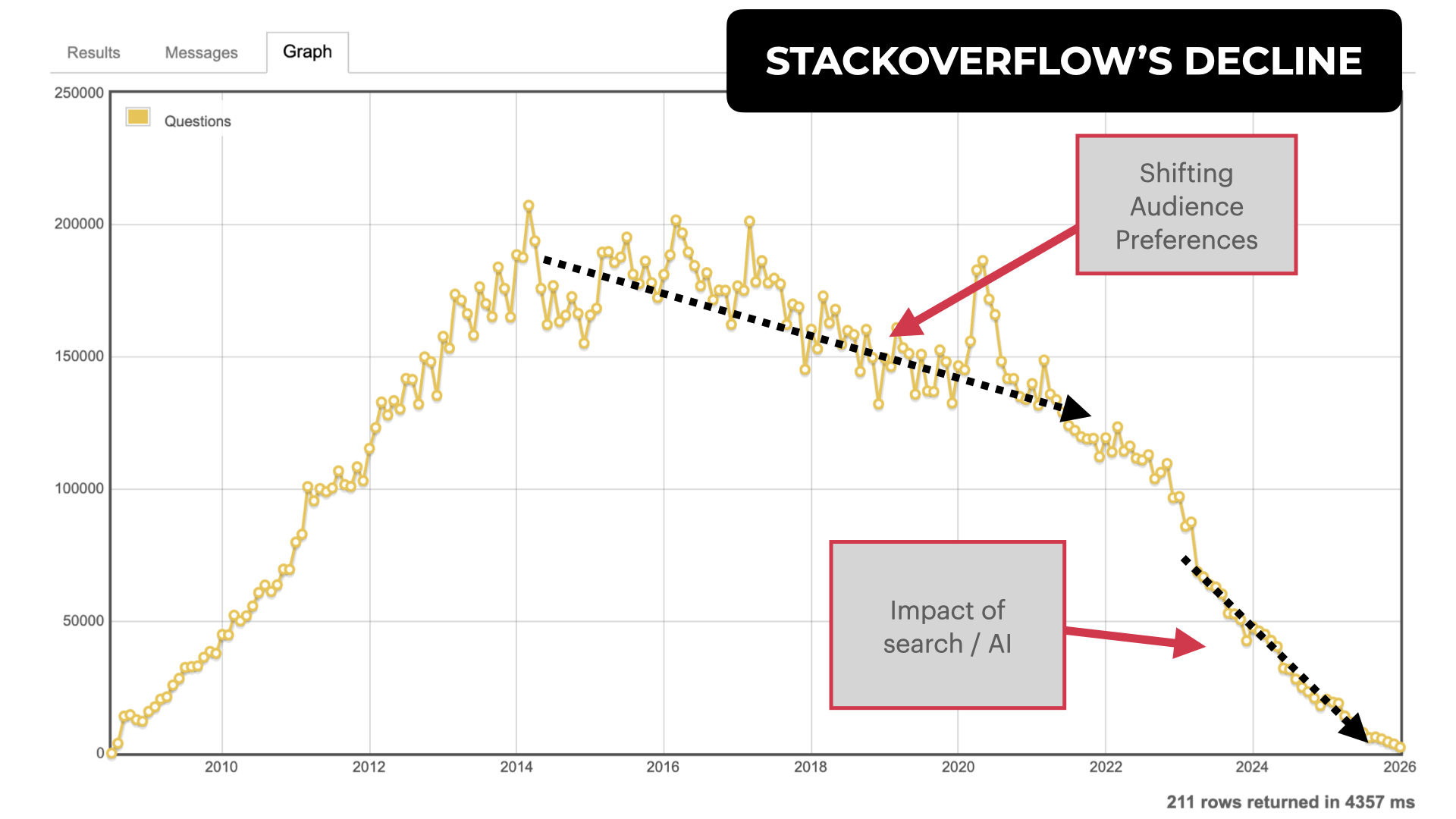
Notice the two patterns here. There was that spell between 2014 and 2023 when engagement began to decline, and then the spell between 2023 and today when things collapsed.
StackOverflow is more impacted by these trends than most, but we all experience them in our own unique way.
So the first challenge is to answer a simple question: to what extent do each of these trends impact you?
Here’s a simple tool that might help:

Five Clear Options For Navigating The Future
Once we know the impact of the trends, we can evaluate the primary options.
Be mindful that these are only the primary options – not a comprehensive list of options.
These are as follows:
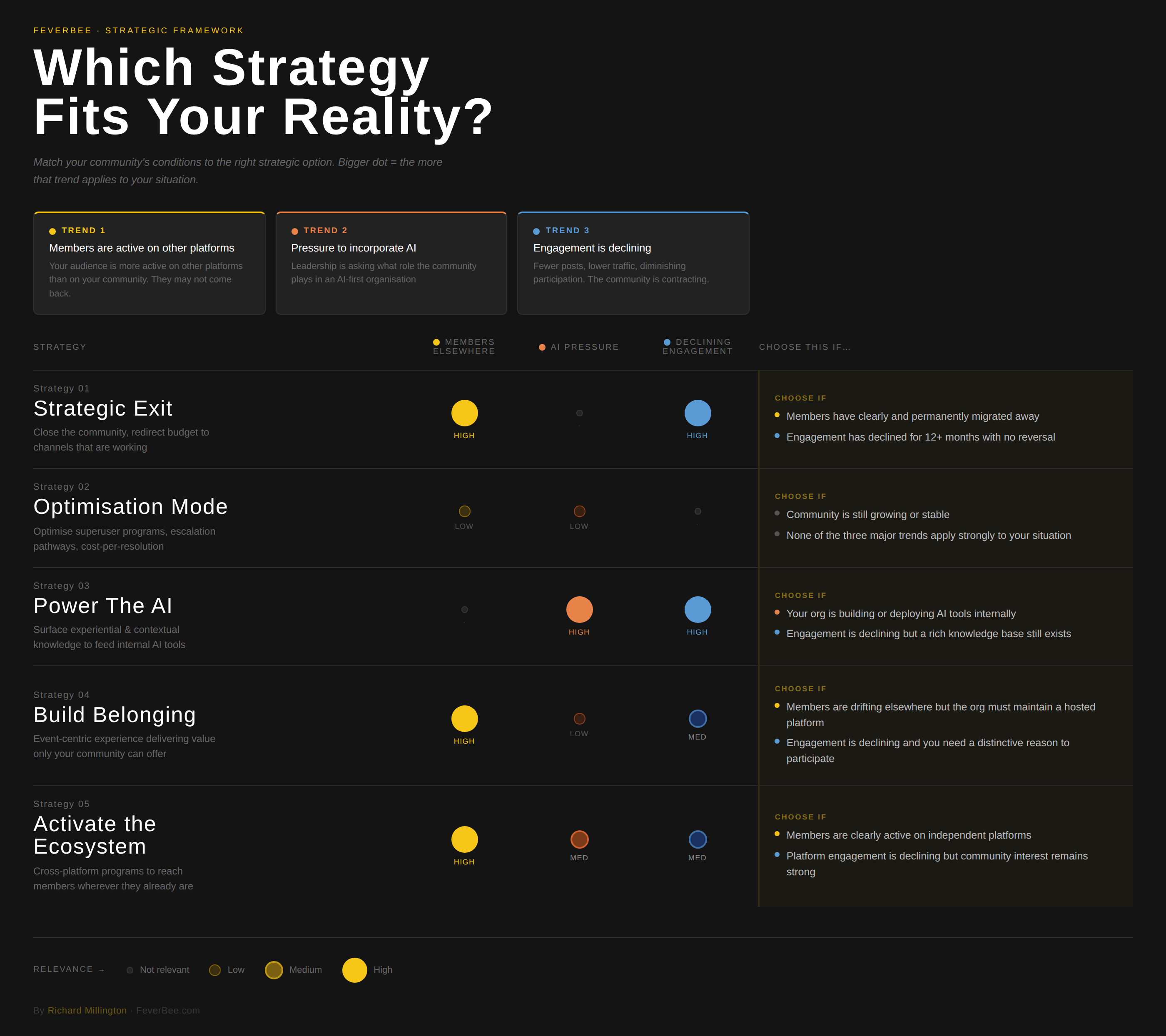
1. Strategic Exit
Save costs and/or eliminate liability by closing the community and focusing engagement on other channels.
Nobody wants to recommend this – because it feels like a failure. However, it’s always on the table and we should be clear why it shouldn’t be the choice.
If your engagement is flat or declining, your community isn’t generating unique knowledge that couldn’t exist elsewhere, and your audience has migrated to LinkedIn, Reddit, or Discord etc… – a strategic exit is the honest answer. You’re spending money to maintain a shrinking ghost town.
Close it, redirect the budget, and focus on channels where your audience actually is.
The missed opportunities and sunk costs are real, but they’re already lost. Keeping a dying community on life support just delays the reckoning while burning resources that could go somewhere useful.
Choose this if: Engagement is static or declining, the community fails to generate unique knowledge, and member preferences have clearly shifted to non-hosted platforms.
2. Optimisation Mode
Reduce costs and optimise current community experience, superuser programs, and escalation pathways.
The most common choice (for now) is to continue doing what you’re doing. You keep optimising the community experience, superuser programs, processes, and more.
This is a great choice if the community is stable/growing, answering a large volume of support questions, and it’s not significantly impacted by the trends reshaping other communities.
The risk here is that you might become a victim of trends you’re ignoring. But the bigger risk is making unnecessary changes to something that’s working just because change feels proactive.
Choose this if: Your community is new or still growing, it answers a large volume of questions, and external trends haven’t meaningfully disrupted it yet.
3. Power The AI
Focus community efforts on facilitating the exchange of experiential, contextual, or ephemeral knowledge to feed your organisation’s AI tools.
This is the option that matters most right now for large enterprise communities where engagement is declining.
It requires a shift from trying to get more people to engage to curating and soliciting unique knowledge.
In this case, you’re trying to solicit unique peer knowledge which isn’t covered in documentation, runbooks, or any existing resources; the workarounds, the edge cases, the “nobody documents this but everyone who’s been doing it for three years knows” knowledge. That’s what your AI tools need. That’s what your community, uniquely, can surface.
This is hard. It requires internal cooperation. It requires accepting that traditional engagement metrics may fall while knowledge quality rises. And yes, the AI hype bubble might burst. But if your organisation is building AI tools and struggling to justify community value, this is your argument.
Choose this if: Engagement is declining in a large, established community, your organisation is developing AI tools, and there’s rising pressure to demonstrate community value.
4. Build Belonging
Create a powerful sense of belonging by developing a unique, engaging, event-centric community experience.
This option returns communities to their roots. It focuses on using events and activities to build authentic, personal connections among members. It works especially well in private and/or exclusive communities.
The goal is to generate advocacy and increase loyalty (or repeat behaviors) by fostering connections among members. The challenge with this approach is that many people don’t want to belong to brands, and you have to accept a smaller, tighter community vs. the current engagement metrics.
If you have internal support for experimentation and a mandate beyond pure support metrics, this is the most rewarding strategic direction.
Choose this if: You’re required to maintain a hosted community experience, the community can legitimately support marketing objectives, and there’s internal appetite to try something genuinely different.
5. Activate The Ecosystem
Develop cross-platform programs to support ecosystem leaders and satisfy member needs wherever they are.
This is the most forward-looking option and, perhaps, the hardest to execute.
It recognises that preferences have changed and audiences now engage with a topic through a myriad of different channels for different reasons. It accepts that assuming you can bring everyone into a platform they’ve left is a fool’s errand and instead aims to add value in the places they have chosen to engage.
It shifts the focus to running cross-platform community programs over solely managing a community platform.
However, the measurement problem is real; you can’t easily attribute business outcomes to activity you don’t control. You’ll need cross-department collaboration that most organisations aren’t set up to provide. And your leadership team will probably ask why you’re investing in platforms you don’t own.
But the answer is simple; it’s where your members are, and meeting them there builds more resilience than trying to drag them back to a platform they’ve already left.
Choose this if: Activity is rising on independent platforms, you want to expand the community’s role beyond support goals, and member preferences are clearly pointing away from your hosted platform.
Make An Active Decision, Don’t Run On Autopilot
These approaches aren’t mutually exclusive or rigid, but more a means of thinking about the right path given the trends taking place right now.
The most important thing is not to continue on autopilot, pretending none of these trends hasn’t (and won’t) have any impact on how you build and develop community.
That’s a surefire path to demise.
A far better approach is to:
- Evaluate the impact of each of these trends (using our simple tool here).
- Consider the strategic approach recommended above (or create your own).
- Develop a strategic plan that aligns with the recommended approach.
(We’re happy to help if you like – feel free to contact us)
The five options above aren’t equally available to every organisation. Your context, budget, and internal politics constrain your real choices. But you should make a conscious choice, not drift.
The big question right now isn’t how to improve the community, it’s which of the five options you’re choosing.
Good Luck!


