


Has Innovation Died in Enterprise Community Building?
Is there any innovation in enterprise community building?
I’ve been attending community events for almost 20 years.
During that time, I’ve sat through dozens of talks on topics like:
- Superuser programs.
- Building a community team.
- Gamification.
- Measuring ROI.
- Hosting and facilitating events.
And many of them have been fantastic, inspiring talks that help create a body of evidence that these methods work.
At the moment, in many cases, you could have given the same talk ten years ago, and pretty much everything (except the names of the vendors) would likely still apply.
Occaisionally, there are flashes of genius moments. Where an individual/brand uncovers a new practice or has an especially compelling story. But overall, this points to a deeper issue; the enterprise community space has been stagnant for new ideas.
There really hasn’t been much innovation in practices, platforms, or measurement.
Up until this year, almost 2/3rds of the talks at major events could fall into the ‘10 years ago’ category.
Which doesn’t make them bad talks – the speakers are still sharing advice that others need to learn. We also often need to hear the same thing multiple times before it seeps in. And sometimes, hearing the same information from a different source is the trick that makes it stick.
And yet…I can’t help but wonder where the innovation is coming from.
What’s at the cutting edge of community building, and what should we be focusing on?
Mapping Out The Top Community Concepts
We can adapt Etienne Wenger’s framework to map our domain of knowledge.
This falls into three core categories.
- Established Practices (Core knowledge)
This is the codified, agreed-upon knowledge of the domain. It’s what we recognize as the current canon, practices, tools, language, and frameworks. It helps to have a large collection of stories and examples here. These kinds of talks are useful. - Emerging Practices (Frontier Knowledge)
These are the experimental practices that push the domain forward. It’s the people exploring new ideas, addressing new problems, and either discarding or embracing ideas that succeed or fail. - Potential Practices (Horizon Knowledge). This is knowledge that is not yet integrated, but is visible and potentially important. It’s the set of possibilities, influences, or questions that might later be drawn into the domain. It’s often driven by technology.
Looking at this, it’s not difficult to put together a broad outline of where everything fits into place right now. You can see this below:
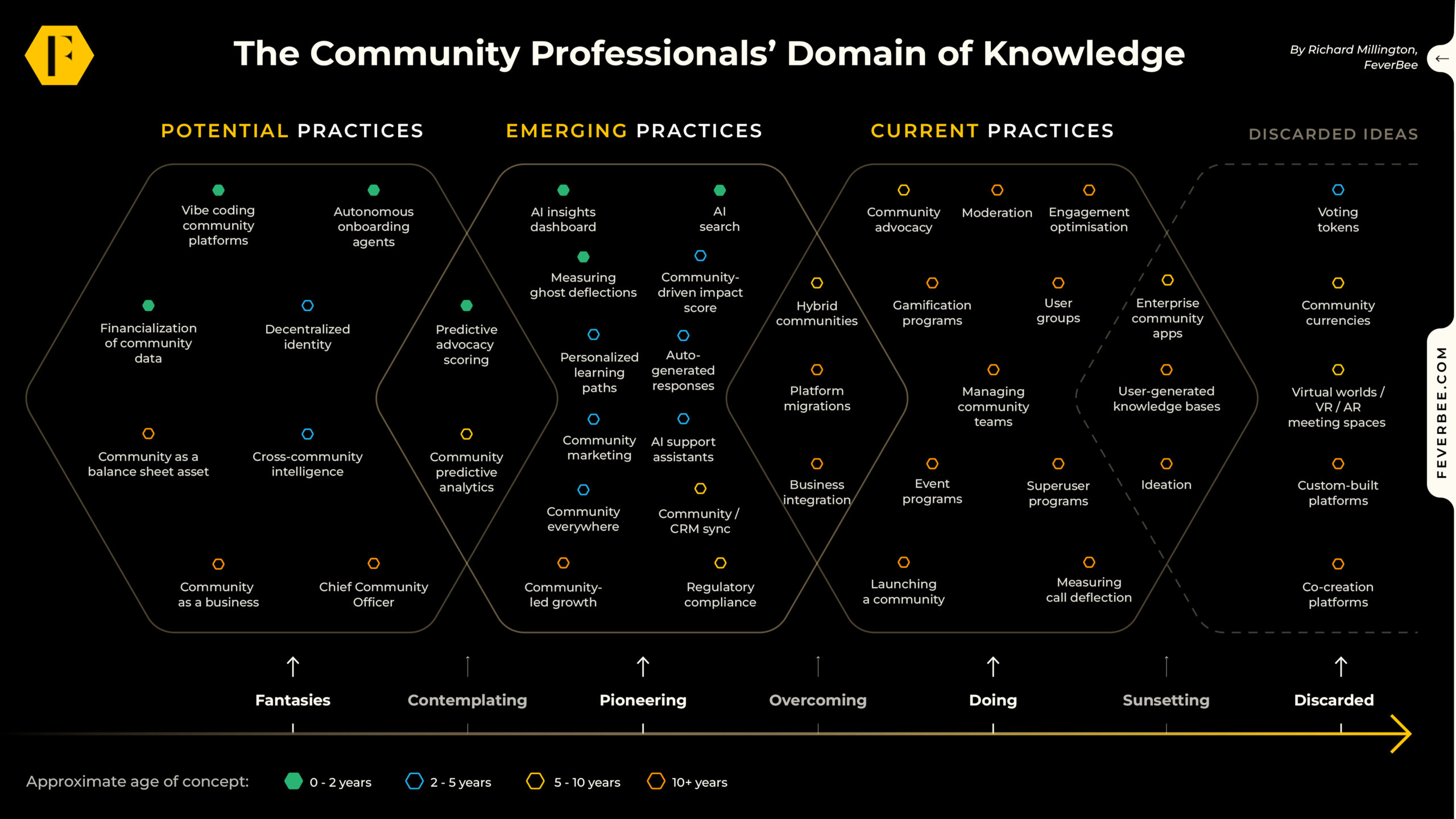
You will notice overlaps to highlight concepts we’re contemplating right now and ever-present challenges we’re attempting to overcome.
You will also notice a category for the ideas that are fading from popularity and those that have been largely discarded (for now).
Let’s go through these in reverse order.
Discarded Ideas (stop talking about these)
While you can still find a handful of examples of these, they’ve largely been discarded in the current era. Most are novel and attract attention, but are almost impossible to implement.
- Voting tokens. Providing members with tokens to vote on key issues impacting the community. An interesting concept that attracts a lot of attention for its novelty, but largely fails due to technical impracticality and problems with the wisdom of the crowd.
- Community currencies. Similar problem to the above – technically hard to implement and ripe for manipulation, abuse, and criminality.
- Virtual worlds. An idea that attracts a lot of participation and engagement for fun, but is discarded mainly by most major brands. Technical requirements make it impractical; it’s occasionally mentioned due to its novelty.
Now we get to the two once-popular ideas.
- Custom-built platforms. Only a real option for a tiny number of huge brands (like Apple) with the resources and technical abilities to create and maintain something.
- Co-creation platforms. With a big exception for the developer space, this concept is a novelty win for PR attention rather than a practical way to create products. Almost every attempt has been a disaster.
Fading Concepts
These are concepts that are still in use but quickly fading in popularity.
- Enterprise community apps. These are still launched, but usually attract very low levels of engagement/participation due to the difficulty in forming the habit of visiting them.
- User-generated knowledge bases. Once the darling of the Web 2.0 world, now usually populated solely by paid employees. The incentives for sharing expertise simply aren’t high enough.
Ideation. Still widely used, but ideas typically resemble complaints – members rarely suggest an idea that gets adopted (and hasn’t already been thought of by product managers). Easy to attract lots of ideas, hard to implement them.
Current Established Practices
This is what the majority of us spend the majority of our time doing. This includes:
- Community advocacy.
- Moderation.
- Increasing engagement.
- Gamification.
- User groups.
- Managing community teams.
- Hosting events.
- Superuser programs.
- Measuring call deflection.
- Launching new communities.
There is plenty of nuance within each of these, and much of our consultancy is about getting the best results from each of these. More stories, examples, and studies on the above would help build the community domain of knowledge.
Everpresent Challenges (Overcoming)
These are the ever-present challenges that community professionals invest considerable time and resources into overcoming.
These include:
- Hybrid communities. How to engage and host members across multiple platforms, such as Discord, Forums, and an app community. What is the right purpose for each channel, and how to get the most from each channel?
- Platform migrations. By far, the thing community professionals dread most is migrating from one platform to another without losing engagement or traffic or causing internal issues. Typically very hard and expensive. An ever-present challenge.
- Business integration. In theory, it’s easy to talk about how the community should interact with different aspects of the business. Still, it’s much harder to do it in practice due to the unique peculiarities of each company.
I doubt any of the above will ever be truly solved.
Emerging Practices (Actively Exploring)
Next, we have the ideas that seem to be gaining traction and are often driven by recent technological ideas.
- AI Insights Dashboard. Good data has been the perennial pain of most community professionals. It’s possible for AI to make it easy to get highly customised data from your community without the need for a ‘data person’.
- AI Search. Essentially, AI provides overviews and predictable answers based on search queries in a community. This is the most predictable addition to most enterprise communities. Most vendors have already included this.
- Measuring Ghost Deflections. Pioneered by Microsoft, this is a possible solution to showcasing the community value in an era of declining search traffic.. A few organisations are now exploring this idea at present, but it’s unclear whether it will gain mass adoption.
- Community-driven impact score
A quantifiable measure of the community’s contribution to business outcomes (beyond deflection) – similar to ESG or NPS scoring models. Easy to implement – awareness might not be a challenge to adoption. - Personalised learning paths
Dynamic, tailored content journeys for members – especially in customer success and product education communities. Can surface community content and contributions to assist in the learning path. Technically tricky, but has enormous potential. - Auto-generated responses
AI-created replies that meaningfully support members while freeing up human moderators and experts for more specialised interactions. Great in theory, might not be as useful to members in practice. - Community marketing. Using community techniques to create and shape perceptions of the organisation and its products/services – primarily outside of hosted platforms. Faces challenges from platform-centric organisations.
- AI support assistants
Assistants are trained on a community’s knowledge base and conversation history to handle routine questions and summarise complex threads. Already in practice – expect rapid widespread use. - Community everywhere
Moving beyond central platforms and engaging members in the channels they prefer to use to accomplish each goal. Aligned with current trends, but tricky to implement due to sunk costs, divisions of responsibility, and measurement. - Community-led growth. A shift towards organisations placing community success as the central purpose and growth coming from the success and engagement of the community. Same challenges as above.
- Community / CRM sync. Deep bi-directional integration where community behaviours update CRM profiles, and CRM data shapes personalised community experiences. Beloved in theory, not as widely adopted in practice as it could/should be.
- Regulatory compliance. Gets surprisingly little attention given its potential significance. New governance requirements (OSAs, GDPR, platform safety laws) that force community teams to adopt compliance-grade processes and tooling. A perennial emerging practice due to the fast-moving regulatory environment.
Piloting (small attempts)
Then there are some ideas that are being proactively piloted by a small few. This includes.
- Predictive advocacy scoring
Using machine learning to identify which members are most likely to become advocates before they exhibit classic behaviours. Use this to design unique communications and journeys. Uncertain how viable this will be in practice. Just because you can predict outcomes doesn’t mean you can meaningfully change the outcomes. Community predictive analytics. Forecasting engagement, churn, and content demand using historical behavioural data and real-time AI modelling. Potentially huge potential, but same challenges as above – will it make an impact? See ‘Future Banned Users’ from the past decade.
Potential Practices (Fantasies – for now)
These are early-stage concepts not yet widely adopted but increasingly viable due to technology shifts.
- Vibe coding community platforms
Using AI tools, it’s now feasible to create or customise community platforms using ‘AI-assisted coding’ (vibe coding). Likely to be useful for minor development work than building entire platforms from scratch. - Autonomous onboarding agents
Self-directed AI agents that onboard members automatically, personalise guidance, and monitor early-stage behaviour to improve retention. Already being tested, uncertain whether it’s possible to impact outcomes over the long term meaningfully. - Financialisation of community data
Reddit and Stack Exchange have shown that you can sell community data for considerable sums. It may be a viable way to monetise larger, more mature communities. But it raises significant ethical questions. - Decentralised identity
Portable, verifiable identities that let members move reputation between communities without relying on platform-specific profiles. Already exists in some platforms, but is far from universal. Could be the answer to ‘login hell’. - Community as a balance-sheet asset
Treating community value as a formalised asset with quantifiable financial value recognised in reporting and investor relations. Similar to the value placed on intangible goods (the brand), etc… - Cross-community intelligence
Aggregated insights across multiple communities that identify trends, member behaviours, and predictive indicators at the ecosystem scale. Amongst the most feasible and likely concepts. - Community as a business
A fully revenue-driven community model where the community itself becomes a standalone revenue line – beyond support deflection or retention value. - Chief Community Officer. Formal recognition of community as a core business function with C-suite representation, paralleling CCO/CMO evolution 15 years ago. Has been talked about for at least 15 years – unlikely to gain widespread adoption anytime soon (or ever).
The Drive Towards Innovation
I’ve written a few times about how the playbook for community hasn’t really changed much over the past decade.
Decide your goals, select your platform, seed some activity, incentivise some top members, and grow via search traffic over time. And the established practices section almost entirely reflects that.
This doesn’t mean innovation isn’t possible within established practice. It just means there’s a law of diminishing returns by focusing on these areas. There are only so many ways you can incentivize superusers and run events, etc.
I suspect the bigger wins are to review, pilot, and report back on the emerging practices as they become incorporated into the community section. If we want to escape the community recession, we need to breathe fresh life into the industry.
You might add/remove different concepts to the above and place them in different categories. That’s expected. But we should hopefully agree that we need more discussion and content on emerging practices vs. decade-old established practices.
Good luck!