

If I asked you how much your community is worth, could you tell me?
Most community managers can’t.
These same community managers will then complain they don’t get the attention or support they need.
If you’re not getting the attention or support you need, it’s your fault. You’re not properly establishing the value of your community.
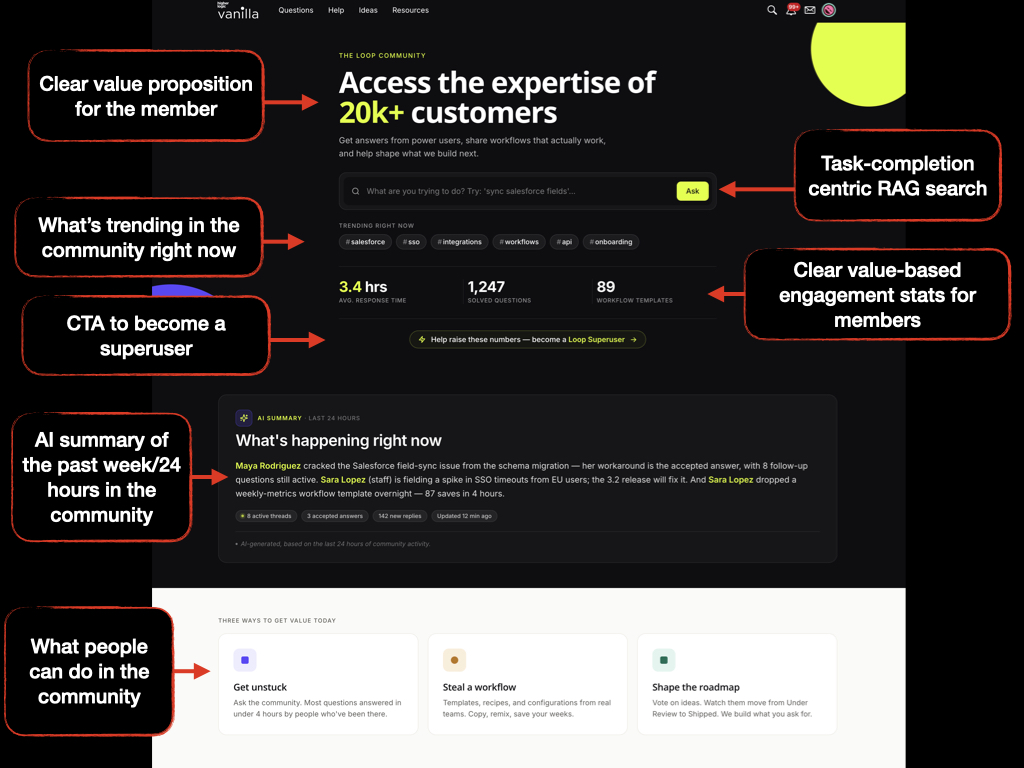
You have to talk about your community in value-based terms.
You can’t establish value if you don’t talk about the value.
Ultimately, your community must have do one of three things.
- Increase sales.
- Reduce costs.
- Fulfill your mission (non-profits).
When you increase sales or reduce costs, profits rise and shareholders are happy.
You need to link what your community to one of these three goals. If you can’t, your community is worthless. It’s entirely possible to have a very successful, but ultimately worthless, community.
Once your organization works that out, they’ll rightly stop supporting the community. You need to make sure all stakeholders understand the value of your community.
For example, if you’re building an internal online community, you need to talk about how it increases productivity, lowers attrition, increases innovation or improves morale. You can connect all of these to reduced costs or higher sales.
If you’re building a customer community, you need to talk about how it increases repeat sales, improves loyalty, generates amazing new product ideas.
If you’re building a client community, talk about sales leads generated, new services developed to match identified needs and referrals gained.
Measure the value, not the actions
This means you need to measure the value, not the actions.
The number of members, fans, and activity within the community are irrelevant to your organization. You measure growth, engagement and development to understand the community’s health. That’s your job. Those metrics are critical for you.
You measure the value to understand it’s worth to the organization. These metrics are critical to your organization. If your community isn’t generating good value, your organization should cancel the community.
Once you connect the community to the value it offers, you can determine what value it’s delivering. Remember, value isn’t just what it’s achieved so far, it’s the value of what it could achieve in future years.
Lets take a simplified example.
Lets image you run a community which sells skis. You create a skiing community. You have 15,000 active members over the year and you establish, through systematic sampling techniques, they now spend 15% more than they did before they joined the community.
If they used to spend $300 per year, they now spend $345. That’s $45 extra per member and approximately $675,000 additional revenue per annum in the community. This is a defensible figure.
Once you establish your community is generating an extra $675,000 per year in sales, how will your organization will treat you then? Might it be easier to ask for a budget to hire additional community managers, develop the platform? Take professional community management training?
Value of recruitment communities
Here’s another example.
Imagine you sell a recruitment product/service. You might set up a community for HR professionals with a view to understanding your audience, making connections and generating sales leads.
You set up a community, get people to join, write content, host events etc…
Through getting to know members, you begin understanding your audience and generating sales opportunities.
In the first year you might generate 7 sales of your product. If your product sales for £15,000, that’s a potential £105,000 in value.
This doesn’t include future years, longer-term engagements, greater efficiency (getting better at networking) and referrals. This could easily double or triple the value of your community over a matter of years.
Suddenly you’re not a low-level community manager, you’re responsible for driving a tremendous amount of value.
Value of Non-Profit Communities
Here’s a final example.
Let’s imagine you manage an online community for a non-profit.
You don’t have a financial motive, you need to fulfill your mission.
If you run a cancer support site, as two participants on the previous Pillar Summit course did, you need to assess the value of your community.
You might survey members before and after they join. After a period of time you can ascertain they feel 60% happier with your organization, have 20% less cancer-related problems etc…
Again, you’re no longer the community manager minion, you’re the person responsible for executing a bulkwark of your organization’s mission.
Don’t wait for the value question to arise
Don’t wait for someone to question the value of your community. Get ahead of the question. Establish the value today.
Ask about the value on your first day on the job. If it’s low, then it’s your job to make it better. If it’s high, then you have a level of authority to get things done.
If your company doesn’t know the value, make it your mission to establish it. Show your organization that you speak their language. Show your organization you’re committed to establishing value.
One of the biggest challenges we face is changing the concept of community management. We need to change it from the person that moderates facebook discussions to a clear value-adding discipline.
Make sure everyone knows that your community is one of the most respected value-producing assets you have…because it probably is.
If you want to learn more, enroll in the Pillar Summit’s Professional Community Management course. Applications close on February 20.